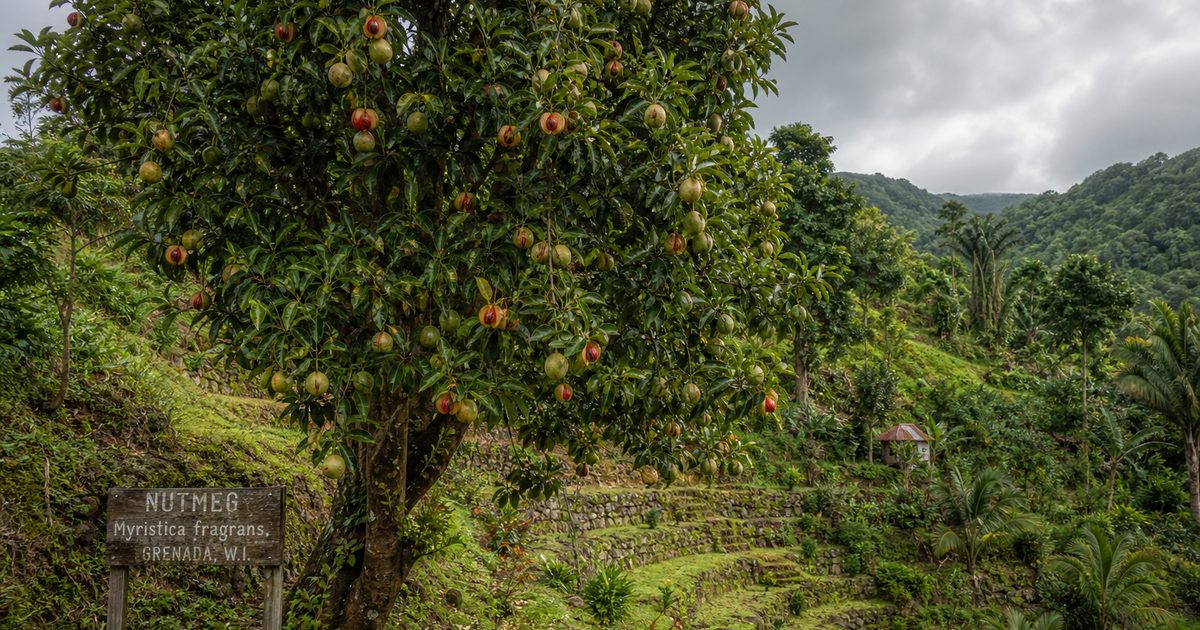
A nutmeg fruit opens like a signal flare. Its skin splits on the branch, and the seed inside appears wrapped in a red web of mace. On Grenada, that small botanical drama became a way of organizing land, labor, and rural life.
The island’s reputation as the Spice Isle rests on something more substantial than branding. Grenada spice production changed the countryside after the age of sugar. It favored tree crops over cane, smallholdings over vast estates, and cooperative marketing over plantation command. Nutmeg became the emblem, but the larger story is how a spice economy remade an island.
Before nutmeg, sugar shaped the land
Grenada did not begin as a spice island. Long before Europeans arrived, people from the South American mainland had reached it. Archaeological evidence places Saladoid settlement around 200 to 300 BCE. By the late precolonial period, the island was inhabited by Indigenous peoples commonly identified as Kalinago, though the exact relationships among earlier groups remain a matter of scholarship rather than certainty.
Columbus sighted the island in 1498 on his third voyage and named it Concepción. French settlers established a colony in 1649. The British captured Grenada in 1762 during the Seven Years’ War, and the Treaty of Paris ceded it to Great Britain in 1763.
Under colonial rule, the island was drawn into the plantation economy that defined much of the Caribbean. In the 18th century, sugar dominated. Like other sugar colonies, Grenada depended on enslaved labor. That system concentrated land in large estates and fixed the best agricultural ground inside a plantation structure.
The later rise of spices did not erase that history. It grew from a landscape already marked by slavery, estate boundaries, and export agriculture. What changed was the crop, and then, gradually, the social map around it.
How nutmeg took root
The beginning is less tidy than the legend. Some accounts credit Sir Joseph Banks with introducing nutmeg to Grenada in 1782. Others place the introduction under the French in 1843. The exact route remains disputed, so it is better to say only what the record supports clearly: nutmeg spread successfully on the island and expanded under British rule as sugar declined.
That success had a practical basis. Grenada is steep, wet, and volcanic. Its interior rises to Mount St. Catherine, about 840 meters above sea level. Those conditions suit Myristica fragrans, the evergreen tree that produces nutmeg and mace. It is a crop for patient farmers. A tree may take seven to nine years to bear, and it can remain productive for decades after that.
The fruit offers two saleable products. The seed becomes nutmeg. The red aril around it is dried as mace, often the more valuable spice. Other crops also found a place in the same environment: cinnamon, ginger, turmeric, cloves, bay leaf, pimento, vanilla, and cocoa. Yet one tree came to stand for the whole system.
By the early 20th century, Grenada had become one of the world’s leading nutmeg exporters. It is still among the major suppliers of the spice. Figures often cited for global market share vary, so broad phrasing is safer than a precise percentage unless a source is specified. What is not in doubt is the scale of the achievement for a small island state.
The crop that broke up the estate
The deepest change was not export volume. It was land use.
Sugar works best on large, tightly managed estates. Nutmeg does not demand the same arrangement. Tree crops can thrive on smaller plots, and in Grenada they increasingly did. As sugar weakened and spices expanded, more rural families gained access to land. A landowning peasantry emerged, distinct from the older plantation order.
That shift matters because it set Grenada apart from many Caribbean islands where large estates remained dominant for longer. Here, the countryside became more fragmented in the literal sense: hillsides and valleys divided into smaller holdings, often worked by families growing a mix of crops. Cane fields impose a visual discipline on the land. Spice trees create something looser and more layered. Nutmeg, cocoa, breadfruit, banana, and provisions can share the same terrain.
The result was not a clean break with the colonial past. Estate patterns and inequalities did not vanish overnight. Still, the move from sugar to spices altered settlement and ownership in ways that were unusually significant. The phrase Spice Isle has endured because it names a real transformation, not just a fragrant export.
Why small growers needed a cooperative
A tree that takes years to mature creates a particular kind of risk. Farmers must wait, maintain, dry, sort, and sell. They also face price swings they cannot control. On an island of many smallholders, that problem called for collective organization.
The Grenada Co-operative Nutmeg Association, usually known as the GCNA, was established in 1947. Its role was practical: to buy nutmegs from growers, oversee grading and processing, and market the crop collectively. In a small-grower economy, that kind of institution can be as important as the tree itself.
The cooperative model tells us something about the structure of rural Grenada. Where agriculture is widely dispersed, power also has to be assembled. Individual farmers may own the land, but they still need shared systems for export, standards, and bargaining. The GCNA became one of the clearest expressions of the island’s post-sugar agricultural order.
That order also shaped farming methods. Many growers worked with limited synthetic inputs, partly from habit, partly from cost, partly because mixed small farms on steep ground lend themselves to lower-input cultivation. It would be too neat to call the whole sector organic without qualification, but traditional practices such as composting, intercropping, and crop rotation have long been part of the island’s agricultural life.
Nutmeg’s prestige, and its fragility
For centuries, nutmeg carried a reputation out of all proportion to its size. In earlier periods of the global spice trade, people believed it could ward off plague or treat common illness. Those claims belong to the history of belief, not to modern medicine, but they help explain why the spice once commanded such fascination.
On Grenada, though, nutmeg’s importance was always more grounded. It paid for school fees, supported households, and tied families to plots of land over generations. That made the crop valuable in a way no old European myth could capture.
It also made the island vulnerable.
In September 2004, Hurricane Ivan devastated Grenada. Reports widely stated that about 90 percent of the island’s nutmeg trees were damaged or destroyed. For a perennial crop, that was not a one-season loss. A young tree cannot replace a mature one quickly, and a replanted hillside does not return to full production in a year or two. Recovery took time because time is built into the biology of nutmeg.
That is the weakness of a tree-crop economy. It can be stable across decades, then suddenly exposed by one storm. A field of annual crops can be replanted after disaster. A nutmeg grove asks for a longer bargain.
Climate pressure on the Spice Isle
Ivan was a shock, but it also revealed a larger problem. Grenada’s spice economy depends on long-lived trees, regular rainfall, and slopes that do not respond kindly to extreme weather. Stronger storms, erratic rain, heat stress, and soil erosion all place pressure on that system.
Climate change is often discussed in abstract terms. On this island, it is easier to see it as a question of agricultural timing and survival. What happens to a rural economy built around trees that need years to mature if hurricanes arrive before those years have passed? What happens to quality if drying conditions become less predictable? What happens to small farmers if recovery stretches beyond a household’s savings?
Those are not future riddles. They are already part of the logic of farming in Grenada.
Reinventing the spice economy
The response has not been to abandon nutmeg. It has been to make the sector less exposed and more valuable.
Replanting programs have supported growers after storm damage. The GCNA remains central to that effort, and government-backed initiatives have aimed to restore production while improving resilience. Farmers have also turned to diversification and agroforestry, not as fashionable terms but as practical strategies. Mixed cropping spreads risk. Shade and tree cover can help protect soil and moisture. A farm that depends on one export alone is easier to break.
There is also a push toward value-added production. Raw spice exports bring one kind of income. Processed oils, oleoresins, packaged seasonings, cosmetics, and branded products bring another. For a small producer, quality and identity may matter more than sheer volume.
That shift helps explain why the island’s spice story is still alive. Grenada is not simply preserving an old trade. It is trying to convert agricultural reputation into a more durable economy. Efforts around certification and legal protection for origin fit that same pattern. The point is not nostalgia. The point is leverage.
Reading the landscape through spice
The clearest evidence of the spice economy is not a slogan on a signboard. It is the shape of the countryside.
Across Grenada, the land still bears the marks of the move away from sugar. Instead of broad cane monoculture, there is a patchwork of smaller plots and mixed tree crops. Nutmeg drying houses and processing stations belong to that landscape as much as the groves themselves. So do village patterns tied to smallholder agriculture rather than to a single estate center.
Even where tourism now dominates the national image, the agricultural interior tells a different story. The scent of nutmeg in a market stall is only the surface trace of a deeper history: a crop that changed ownership patterns, encouraged cooperative institutions, and gave rural families a different relationship to land than sugar had allowed.
That is why Grenada’s spices matter beyond cuisine. They explain how an island can carry the legacy of plantation agriculture and still develop a countryside not wholly defined by it. Nutmeg did not undo colonial history. It did, however, redirect it.
FAQ
Why is Grenada called the Spice Isle?
Because spices, especially nutmeg and mace, became central to the island’s agriculture and identity. The name reflects a real shift in land use and exports, not just tourism branding.
How did nutmeg change Grenada?
Nutmeg helped move the island away from large sugar estates toward smaller family holdings. That changed rural settlement, land ownership, and the need for cooperative marketing.
When was nutmeg introduced to Grenada?
The exact date is debated. Some accounts say 1782, others 1843. What is clear is that nutmeg expanded successfully as sugar declined under British rule.
What is the Grenada Co-operative Nutmeg Association?
The GCNA is the cooperative body that organized buying, grading, processing, and marketing for nutmeg growers. It became a key institution in a smallholder-based agricultural system.
What happened to Grenada’s nutmeg industry after Hurricane Ivan?
Hurricane Ivan in 2004 devastated much of the island’s nutmeg stock, with reports commonly citing damage to about 90 percent of the trees. Recovery was slow because nutmeg trees take years to mature.