More than 1,400 rhesus macaques crossed from Puerto Rico to South Carolina in nine shipments between 1979 and 1980. Transport separated animals that had lived together, but after their release on Morgan Island, they quickly reassembled their social groups. The journey had disrupted their relationships without erasing them.
That small detail changes the familiar image of “Monkey Island,” the wooded shore north of Beaufort where macaques sometimes appear above the tidal creeks. These were not escaped pets establishing themselves by chance. They arrived as a managed population, bringing an existing social world into a landscape chosen for its isolation.
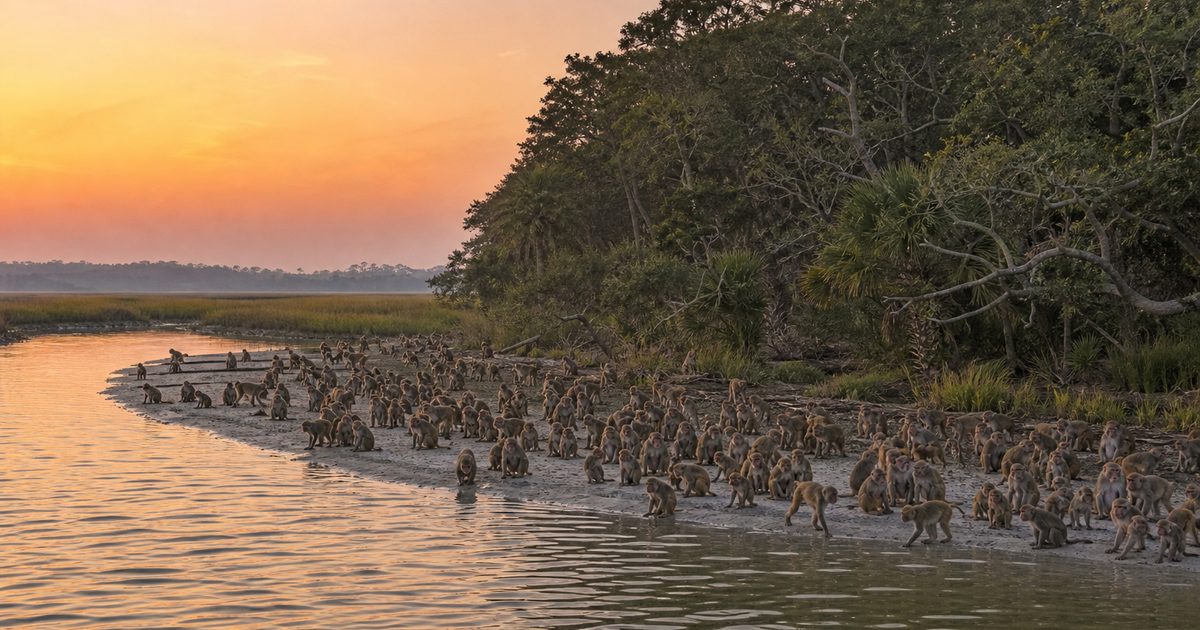
Their descendants form a free-ranging breeding colony, generally estimated at 3,000 to 4,000 animals. They move through maritime forest, forage and raise young. They also belong to a federal biomedical program that supplies mainland laboratories. Understanding the island means holding those facts together.
The colony that came from Puerto Rico
The animals’ route to the South Carolina coast began at a primate facility near La Parguera, Puerto Rico. Rhesus macaques, Macaca mulatta, had been established there for biomedical purposes during the mid-20th century.
By the 1970s, monkeys escaping beyond the facility had become a concern. Their presence outside the colony raised questions about containment and the possibility of disease transmission to nearby communities. Those concerns helped drive the search for another location.
Herpes B virus was an important part of that risk. Macaques are its natural hosts and often show little or no sign of infection. In humans, infection is rare but can cause severe neurological disease and death.
That distinction needs care. The presence of infected monkeys does not establish that an outbreak occurred among nearby residents. Nor does the severity of human infection describe the likelihood of catching the virus while watching animals from a boat. Exposure usually involves a bite, scratch or contact between infectious material and broken skin or mucous membranes.
South Carolina offered a setting where water could help maintain separation between the colony and surrounding communities. In 1979, the relocation to Morgan Island began.
Nine shipments, existing loyalties
The South Carolina Department of Natural Resources and the National Institute of Allergy and Infectious Diseases helped organize the transfer. Nine shipments carried more than 1,400 animals to their new home over two years.
The move involved losses. Reported mortality during transport was approximately 0.65 percent, with infants accounting for most deaths. The percentage was small; the deaths nevertheless fell disproportionately among the youngest animals.
Once released, monkeys separated during shipping reunited with their former groups. For a social primate, that mattered. Rhesus society depends on recognizable relationships, including maternal kinship and hierarchies that influence access to food, space and support during conflict.
The relocation therefore moved more than a breeding population. It transferred established groups whose relationships could continue in a different habitat.
The island’s lack of a permanent residential population made it useful to the program. Its creeks and marshes provided separation without requiring the animals to spend their lives in cages. Isolation became part of the colony’s management.
A small forest within a tidal landscape
Morgan Island lies in Beaufort County, in the ACE Basin estuarine region. Its commonly reported area is about 4,489 acres, or 1,817 hectares, but that figure can give a misleading impression of the monkeys’ habitat.
Most of the island is marsh. Upland accounts for approximately 635 acres, or 257 hectares, and the macaques principally occupy about 370 acres, or 150 hectares, of maritime forest.
The distinction is visible in the landscape. Woodland rises above low expanses threaded by tidal water. A monkey seen near the shore occupies the edge of a much larger system of creeks, mud and marsh vegetation, rather than an island covered continuously in trees.
Within their wooded range, the macaques live in social groups and reproduce. Females have been reported to make up roughly three-quarters of the population, a composition consistent with the colony’s breeding role. Population estimates fluctuate, so the often-quoted total of 3,000 to 4,000 should not be read as a fixed census.
“Free-ranging” describes how the animals live and move. It does not mean that they receive no human care, that their numbers go unmanaged or that they exist outside institutional ownership.
The boundary between island and laboratory
Ownership separates the land from the animals. The South Carolina Department of Natural Resources owns Morgan Island. The National Institutes of Health, through the National Institute of Allergy and Infectious Diseases, owns the macaques.
Private contractors manage the colony. Charles River Laboratories previously performed that work; Alpha Genesis took over in 2023 under a federal contract reported at approximately $4.1 million annually. Those details belong to a particular contracting period, rather than describing an arrangement that can be assumed never to change.
The underlying purpose is breeding animals for biomedical research. Accounts of the operation describe annual transfers of approximately 500 to 600 macaques to mainland facilities. Research associated with the colony has included infectious diseases, vaccines and other medical applications.
No invasive research takes place on the island itself.
That boundary explains much of the confusion surrounding the place. The woodland is a breeding environment, not an outdoor laboratory where the procedures associated with biomedical experiments occur. Yet the animals’ lives there remain connected to what happens after they leave.
Calling the island a sanctuary obscures that connection. It suggests retirement or permanent refuge, neither of which describes a colony supplying research facilities.
The reverse caricature is misleading too. Claims about sinister experiments hidden in the forest substitute speculation for the documented operation. The ethical questions are substantial enough without embellishment: the breeding of social primates, their removal from established groups and their eventual use in research.
Why the shore is closed
Morgan Island is not open to the public. Landing without authorization is prohibited, and posted warnings state that trespassers may face prosecution.
The restrictions protect people and animals. Close contact with macaques carries a disease risk, while visitors can disturb the colony or introduce hazards of their own. Feeding creates particular problems by encouraging animals to approach people and associate them with food.
A quiet beach does not change those conditions. Nor does a monkey sitting within easy sight of a passing boat make the shoreline a public wildlife-viewing area.
Boat excursions in the surrounding waters offer a way to look without entering the habitat. Sightings depend on where the animals happen to be; they may appear at the woodland edge or remain out of view. Observation should not involve feeding, calling animals closer or attempting to land.
Sensational descriptions such as “America’s deadliest island” confuse a specific contact hazard with a general atmosphere of danger. Herpes B warrants strict precautions. It does not justify treating every distant sighting as an imminent threat.
The water marks a practical boundary: the public can observe from outside a colony whose daily operation requires controlled access.
What the monkeys leave behind
A population of several thousand introduced primates also raises an ecological question. Breeding success says little, by itself, about the condition of the habitat supporting it.
Environmental studies have reported localized effects around the colony. Measurements found elevated fecal coliform levels in adjacent creeks, although the recorded levels did not exceed the recreational water standards used in those assessments. That finding describes particular samples and conditions. It is not a permanent guarantee of water quality.
A comparison covering 1979 to 1999 reported a 35 percent increase in canopy cover. This complicates the assumption that decades of occupation must have produced wholesale woodland loss.
Canopy cover, however, measures only one feature of a forest. It cannot establish whether understory plants, soil conditions or native wildlife remained unchanged. Equally, the presence of an introduced species does not, without evidence, establish that every part of the surrounding ecosystem has deteriorated.
The useful questions are specific: what changed, where did it change, and over what period?
Those questions are easy to lose when attention settles on the novelty of monkeys in South Carolina. A brief sighting offers little indication of population management or environmental monitoring. One macaque disappears into the branches; the colony, its habitat and its institutional obligations remain.
FAQ
Why are there monkeys on Morgan Island?
More than 1,400 rhesus macaques were relocated from Puerto Rico in 1979 and 1980. They established a managed breeding colony supplying animals for biomedical research.
Can you visit Morgan Island in South Carolina?
The island is closed to the public, and unauthorized landing is prohibited. Boats can observe from surrounding waters without entering the colony or disturbing the animals.
Are the Morgan Island monkeys dangerous?
Macaques can bite and scratch, and they can carry Herpes B virus, which can cause severe illness in humans. Do not approach, touch or feed them. Watching from a distance is different from direct exposure.
Are experiments performed on the island?
No invasive research takes place there. The island serves as a breeding colony, and animals are transferred to mainland facilities for biomedical research.
How many monkeys live on Morgan Island?
The population is commonly estimated at 3,000 to 4,000 rhesus macaques. Births, deaths and transfers mean that the number changes.