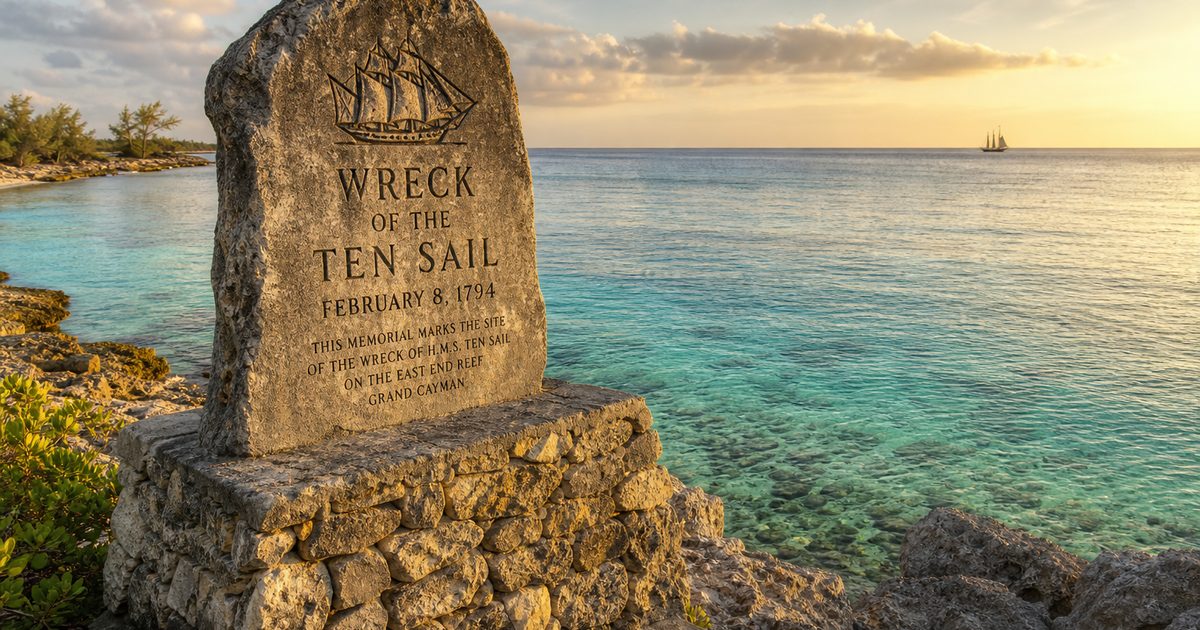
On 8 February 1794, ten merchant ships struck the reefs off Grand Cayman’s East End. The rescue that followed became local memory, then legend. Yet the deeper story lies elsewhere: not in one wreck, but in the long habit of living by water on islands that offered little else.
That habit shaped the Cayman Islands more than any plantation ever did. Grand Cayman, Cayman Brac, and Little Cayman cover only 264 square kilometres. Their soils are thin. Large-scale sugar cultivation never took hold in the way it did on many other Caribbean islands. So the sea became pantry, road, workplace and risk. Long before the territory was known for offshore finance, it was known for turtles, small craft, shipwrights and men who signed on to vessels far beyond the western Caribbean.
If you want to understand Cayman maritime history, start with that constraint. The islands did not turn to the sea out of romance. They turned to it because the land set limits.
Named by sailors, known for animals
The written record begins offshore. On 10 May 1503, Christopher Columbus sighted Cayman Brac and Little Cayman and called them Las Tortugas because of the sea turtles in the surrounding waters. The first European name for the islands came not from a harbour, a ruler or a crop, but from marine life.
Later maps changed the label. A map of 1523 used Los Lagartos. Between 1526 and 1530, the name Caymanas appeared, drawn from a Carib word for marine crocodile or caiman. By the time Sir Francis Drake visited Grand Cayman in 1586, he too remarked on the abundance of turtles and referred to “great serpents called Caymanas.”
Those shifts matter because they show how the islands entered imperial geography. They were not first valued for fertile land or strategic fortifications. They were noticed as places where passing ships could find living resources in the water. In that sense, the Cayman Islands were maritime before they were settled.
Why the sea came first
Permanent settlement arrived late and unevenly. The first recorded English settlements on Little Cayman and Cayman Brac date to the period between 1661 and 1671, but Spanish privateer attacks disrupted them. England formally gained control of the islands, along with Jamaica, under the Treaty of Madrid in 1670. More durable settlement followed in the 1730s. The first royal land grant on Grand Cayman was issued in 1734 by the Governor of Jamaica.
What settlers found was not a future sugar colony. Thin soils and limited fresh water discouraged plantation agriculture on the scale seen elsewhere in the Caribbean. That absence shaped the social and economic life of the islands. Where other colonies built wealth on cane fields and mills, Caymanians built livelihoods on reefs, channels and open water.
Turtling became the first major export trade. Sea turtles supplied food for sailors and a market in Jamaica. In 1787, Captain Hull estimated that Caymanian turtlers sold between 1,200 and 1,400 turtles a year in Jamaica. That figure gives a sense of scale, and of pressure. The trade lasted for centuries and severely depleted turtle populations.
This was more than extraction. Turtling trained people in navigation, weather, currents and the practical discipline of working at sea. Men who chased turtles across Caribbean waters learned routes, markets and maritime timing. The economy looked outward because it had to.
Isolation, traffic and the pirate reputation
The same geography that favoured turtlers also fed a darker reputation. The islands sit between Jamaica and the Yucatán Peninsula, in waters crossed for centuries by merchant shipping, naval patrols and private ventures of every kind. For seafarers who wanted shelter, supplies or concealment, the Caymans could be useful.
That is why pirates and privateers appear so often in Cayman Islands history. Names such as Henry Morgan, Edward Teach, known as Blackbeard, and Lowther recur in local tradition and later retellings. Some claims are hard to pin down. The idea that Blackbeard buried treasure in caves on Cayman Brac belongs to legend, not established fact.
What can be said with confidence is simpler. The islands were woven into the movement of legal and illegal shipping through the western Caribbean. Their isolation was never absolute. It was functional. It made them hard to monitor and easy to use.
Boats made the society
By the 1770s, shipbuilding had begun in the islands, first in support of fishing and local trade. Over time, Caymanian shipwrights earned a wider reputation. At the Jamaican Exhibition of 1891, models of Caymanian-built vessels were displayed as examples of skilled craftsmanship.
That craft grew from necessity. A scattered population on three islands needed boats for almost everything: fishing, turtling, carrying goods, crossing channels, reaching markets and navigating dangerous reefs. The result was a society that depended on carpenters, caulkers, sailmakers, riggers, navigators and seamen. Maritime skill was not a specialist pursuit at the edge of life. It sat near the centre.
This world was also shaped by slavery. The first census, taken in 1802, recorded 933 people on Grand Cayman, including 545 enslaved people. Because there was no large sugar economy, slavery in the Cayman Islands did not resemble the plantation model common elsewhere in the region. Enslaved people often worked in domestic labour, small-scale agriculture and maritime trades. That difference should not soften the fact of coercion. The sea economy, like the rest of colonial society, rested in part on unfree labour.
Slavery was abolished in the islands between 1833 and 1835, freeing more than 950 enslaved people of African ancestry. Modern Caymanian society emerged from that history. Pride in seamanship and boatbuilding sits alongside a harder truth: the maritime culture was built by a population whose opportunities and burdens were never evenly shared.
The Wreck of the Ten Sail
Few episodes have done more to shape national memory than the Wreck of the Ten Sail. On 8 February 1794, ten British merchant vessels ran aground on the reefs off East End, Grand Cayman. Local residents mounted a rescue and saved many of those aboard.
The facts are strong enough without embellishment. Reefs, darkness, local knowledge, small boats, urgency: the event distilled the practical seamanship on which the islands depended. It showed that Caymanians knew these waters in ways outsiders did not, and that such knowledge could mean the difference between life and death.
A famous legend grew around the rescue. According to tradition, King George III rewarded the islands by granting freedom from taxation because a member of the royal family had been among those saved. The rescue is historical fact. The royal passenger and the tax exemption story are not established in the same way and should be treated as legend.
Even without that tale, the wreck mattered. It turned everyday maritime competence into a public drama. The skills used to fish, trade and travel became visible as rescue.
A seafaring people into the modern era
The maritime character of the islands lasted well into the 20th century. In 1903, the Cayman Islands Shipping Registry registered its first vessel, the El Paso. The registry was new; the shipping culture behind it was not.
By 1934, more than half of Caymanian men between 18 and 60 were involved in seafaring. Few statistics capture a society so clearly. On many islands, the sea is part of life. Here it was the main livelihood for a striking share of adult men.
After the Second World War, many Caymanians signed on with large international shipping companies. They worked in an industry that demanded discipline, technical knowledge and trust. Wages mattered, of course, but so did exposure to global systems: contracts, registration, insurance, schedules, port rules and the routines of international commerce.
Political change formed the backdrop. In 1863, the Cayman Islands were officially declared and administered as a dependency of the Crown Colony of Jamaica. In 1959, they became a unit territory within the Federation of the West Indies and ceased to be a dependency of Jamaica. When Jamaica became independent in 1962, the Cayman Islands chose to remain under British rule.
That continuity helped create a stable legal framework. Combined with an older outward-looking maritime culture, it set the stage for a new economy.
From shipping registry to financial centre
The leap from turtle fisheries and wooden vessels to investment funds can look abrupt if the sea is treated as scenery. It was not scenery. It was training.
A maritime society learns to operate across distance. It depends on registration, contracts, reputation and service to people whose business lies elsewhere. The shipping registry, opened in 1903, was one expression of that logic. Over time, the islands expanded that role, first in shipping administration and later in financial services.
That does not mean finance simply grew out of seamanship in a neat, inevitable line. Law, politics, regulation and global capital all mattered. But there is a real continuity in function. The islands did not become wealthy by producing bulk goods from their land. They became useful to international networks.
Today the territory is one of the best-known offshore financial jurisdictions in the Caribbean and a major hedge fund domicile. Its GDP per capita was reported at US$97,750 in 2023. The contrast with the old turtling economy is stark. The structure beneath it is less so. In each era, Cayman prospered by serving movement beyond its shores.
That is why the national motto still rings true. “He hath founded it upon the seas” sounds biblical, but it also sounds practical. The modern economy moves capital rather than turtle meat, timber or sailcloth. It still depends on the same outward orientation.
What remains of the maritime past
The older world has not vanished. It survives in sites, objects and place memory. The Cayman Islands Maritime Heritage Trail links locations associated with shipwrecks, turtling and boatbuilding. In George Town, Fort George preserves remains of an 18th-century fort, built around 1790 as defence against Spanish attack. At East End, the Wreck of the Ten Sail Memorial, dedicated by Queen Elizabeth II in 1994, marks the site of the disaster that entered local legend.
The Cayman Islands National Museum holds more than 9,500 artefacts, including a catboat and maritime tools that place seafaring within ordinary island life rather than apart from it. Traditional cottages on Boggy Sand Road in West Bay and the Elmslie Memorial Church, built by Captain Rayal Bodden using shipbuilding techniques and materials, show how marine craft shaped architecture as well as work.
There are pressures too. Marine heritage sits beside marine strain. Heavy visitor numbers, coastal development and population growth have all added environmental pressure to the islands. That context matters when the past is told through turtles and reefs. The same waters that sustained Caymanian life were also exploited, sometimes harshly, and remain vulnerable.
The most revealing story of the Cayman Islands is not the polished one about tax neutrality or global finance. It is the longer one beneath it: a society formed where the land offered little, the reefs offered danger, and the sea offered almost everything.
FAQ
How did the Cayman Islands get their name?
The islands were first called Las Tortugas by Columbus in 1503 because of the many sea turtles nearby. Later maps used Los Lagartos and then Caymanas, a name linked to the Carib word for caiman.
What was the first major Cayman Islands economy?
Turtling was the first major export trade. Caymanian crews caught sea turtles for food and sold them, especially in Jamaica.
Were pirates really active around the Cayman Islands?
The islands were associated with pirates and privateers because of their position in western Caribbean shipping routes. Some stories are well known locally, but not every famous pirate tale can be proved.
What was the Wreck of the Ten Sail?
In 1794, ten British merchant ships ran aground off East End, Grand Cayman. Local residents carried out a major rescue, and the event became one of the best-known episodes in Cayman maritime history.
How did the Cayman Islands become a financial centre?
The islands developed strong links to shipping, registration and international commerce over centuries. In the modern period, that outward-looking economy expanded into shipping services and then financial services.