On June 4, 1942, Japanese aircraft bombed an American outpost with barely 6.2 square kilometers of dry land. Its runways lay inside a reef in the North Pacific. Beyond that reef, American carriers were waiting for the fleet that had sent the bombers.
By June 7, Japan had lost four aircraft carriers. The United States had lost one.
The Battle of Midway takes its name from those small islands, though most of the fighting happened at sea. The atoll was the Japanese objective, an American air base and a source of reconnaissance. It was also the bait in an operation intended to draw the remaining American carriers into a decisive confrontation. Intelligence helped the Americans turn that plan against its authors.
A position waiting for its technology
Midway lies near the northwestern end of the Hawaiian archipelago, outside the State of Hawaii. Sand, Eastern and the much smaller Spit Island sit within an enclosing reef. There is little elevation and no inland refuge: almost everything built here stands close to the sea.
Its position attracted American attention well before aircraft could cross the Pacific. Captain N. C. Brooks reached the islands aboard the Gambia in 1859 and claimed them under the Guano Islands Act. In 1867, Captain William Reynolds of USS Lackawanna formally took possession for the United States.
A mark on a chart did not make a usable harbor. In 1870, the Pacific Mail Steamship Company attempted to create a ship channel through the reef. The project failed.
That failure exposes an important distinction in Midway’s history. Location offered possibilities, but ships still needed safe access, and people needed supplies. The atoll became strategically useful only as communications and aviation supplied reasons to maintain an expensive foothold there.
The decisive changes began with a cable rather than a warship.
The cable station becomes an air base
In 1903, the Commercial Pacific Cable Company established a station on Midway as part of the first transpacific submarine telegraph connection. Messages could pass through an island settlement thousands of kilometers from the continental United States.
That same year, President Theodore Roosevelt placed the atoll under Navy control. Protection against the killing of seabirds formed part of the reason for federal intervention. Military administration and wildlife protection would remain entangled here long after the cable station’s heyday.
Pan American Airways added another layer in 1935, establishing a stop for its transpacific Clipper flying boats. Aircraft needed fuel, maintenance and places to land between widely separated shores. Midway’s isolation, once an impediment, now gave it a purpose.
Naval planners saw a related opportunity. A 1938-1939 study identified the atoll as an important location for patrol aircraft and submarines. Construction of a naval air facility began in 1940, and Naval Air Station Midway Islands was established in August 1941.
Eastern Island acquired runways. Sand Island supported much of the base’s other infrastructure. By the eve of war, Midway could sustain reconnaissance and military operations far beyond its reef.
An exposed outpost
War reached the atoll on December 7, 1941, the day Japanese aircraft attacked Pearl Harbor. Two Japanese destroyers shelled Midway, killing four Americans and wounding ten.
The bombardment demonstrated how exposed the new base was. Its low islands offered little concealment, and an enemy approaching by sea could threaten installations concentrated in a very small area.
Yet the same position made the base valuable to American defenses. Aircraft operating here could search ocean approaches far to the northwest of Hawaii. For Japanese planners, capturing it promised to extend their defensive perimeter and threaten the American position in the central Pacific.
The larger prize was the U.S. carrier force. Admiral Isoroku Yamamoto’s operation sought to bring those carriers out to fight under conditions favorable to Japan. Midway mattered as territory, but the intended destruction of the American fleet mattered more.
The plan depended on surprise, coordination and assumptions about how the Americans would respond. By late spring, American intelligence had begun to undermine those assumptions.
Reading enough of the plan
At Station HYPO in Pearl Harbor, American cryptanalysts worked on intercepted Japanese naval communications. They did not possess a complete, effortless reading of Japan’s messages. JN-25, the principal Japanese naval operational code system, combined coded vocabulary with an additional layer of numerical encryption.
Partial recoveries still yielded useful information. Analysts combined fragments of messages with traffic analysis, operational knowledge and reports from other intelligence stations. They identified Midway as the likely target of an approaching offensive and narrowed its timing.
One episode made that identification more secure. Midway transmitted an uncoded report that its water-distilling equipment had failed. A subsequent Japanese message reported that the target designated “AF” was short of water, helping confirm what the Americans suspected.
The intelligence did not reveal every ship’s movement or remove the hazards of battle. It gave Admiral Chester Nimitz enough warning to concentrate three carriers, Enterprise, Hornet and the hastily repaired Yorktown, northeast of the atoll.
Japanese planners expected to draw American carriers toward their operation. Instead, the Americans were already taking position.
The morning the battle changed
Japanese carrier aircraft attacked Midway early on June 4. Defenders suffered losses, and the bombing damaged installations, but it did not put the airfield out of action.
Aircraft based on the atoll attacked the Japanese force in return. These attacks achieved no decisive hits and cost heavily in crews and machines. Their importance cannot be measured solely by damage inflicted: the Japanese carriers were operating under repeated pressure while trying to manage reconnaissance, defensive patrols and preparations for further strikes.
American carrier aircraft also struggled to find and attack the enemy. Torpedo squadrons suffered devastating losses. The outcome was not a clean execution of an intelligence-led plan; it emerged through failed attacks, incomplete reports and decisions made with little time.
Late that morning, American dive bombers struck Akagi, Kaga and Soryu, leaving all three fatally damaged. In a short interval, the Japanese carrier force lost most of its striking power.
The fourth carrier, Hiryu, remained operational long enough to launch attacks that crippled Yorktown. American aircraft found and fatally damaged Hiryu later that day.
Fighting and losses continued after June 4. A Japanese submarine torpedoed the damaged Yorktown on June 6 and sank the destroyer Hammann, which was alongside assisting her. Yorktown sank the following morning.
By the battle’s end, Japan had lost four fleet carriers and the heavy cruiser Mikuma. The American victory had cost a carrier, a destroyer and hundreds of lives.
A turning point, not an ending
Calling Midway the turning point of the Pacific War is useful only if the phrase leaves room for what followed.
Japan did not cease offensive operations in June 1942, nor did the United States immediately gain uncontested command of the ocean. The fighting around Guadalcanal later that year would be prolonged and costly. Industrial capacity, shipping, training and the attrition of experienced personnel all shaped the wider reversal of Japan’s fortunes.
Midway nevertheless destroyed four major carriers that Japan could not quickly replace. It checked a major offensive and sharply reduced the striking power available for subsequent operations.
The battle also exposed the risks within the Japanese plan. Widely separated forces, uncertain reconnaissance and an expectation of American reactions left little margin when events departed from the intended sequence.
Historians continue to examine Admiral Chuichi Nagumo’s decisions about aircraft armament, launch timing and the defense of his carriers. Those arguments matter, but explanations that reduce the battle to one mistaken order miss its larger circumstances. Intelligence, reconnaissance, American persistence and Japanese operational choices all contributed.
The atoll itself remained in American hands. Japan never carried out the planned landing.
The battlefield after the carriers
Midway continued to serve as a military base after the battle. Personnel numbers grew during the war, and later operations supported American commitments during the Korean and Vietnam wars.
That longer service altered the landscape. Buildings changed use, facilities expanded, and some wartime installations fell out of service. What survives is not a battlefield preserved exactly as it looked on June 4.
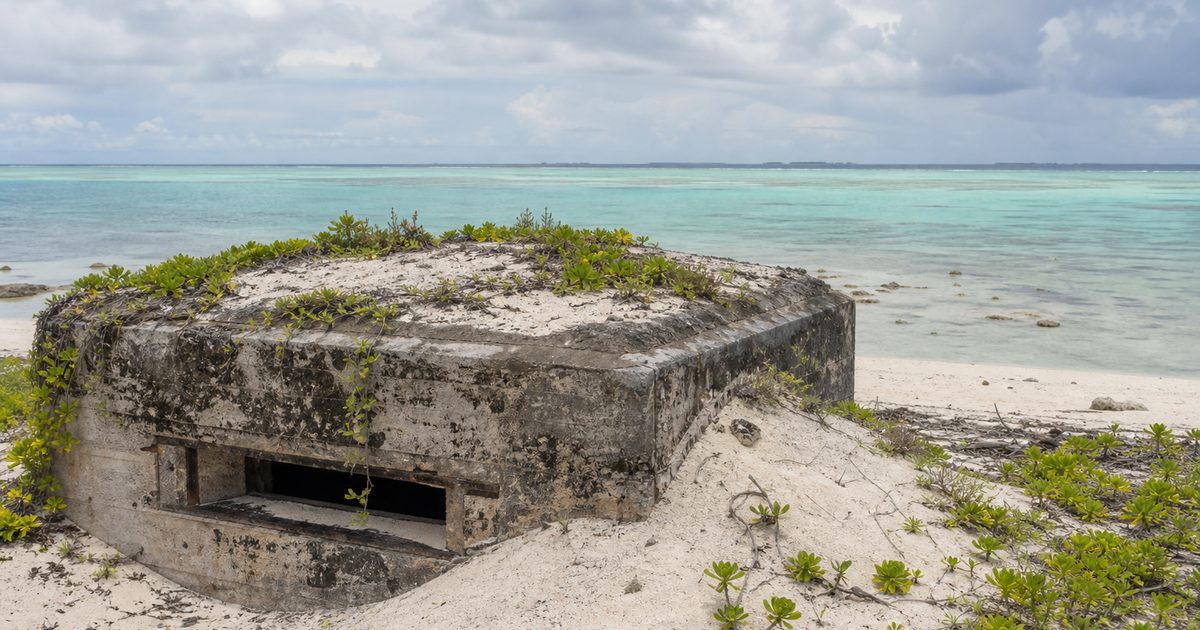
Eastern Island retains traces of its wartime airfield. Defensive positions, including beach pillboxes, remain on the atoll. Sand Island’s Henderson Field continues to provide an emergency landing option for aircraft crossing this remote part of the Pacific.
Federal recognition gradually added protection to the military remains. The World War II facilities at Midway received National Historic Landmark designation in 1987. An overlay national wildlife refuge followed in 1988, while the Navy still administered the base. Naval Air Facility Midway Island closed in 1993, and responsibility subsequently passed to the Department of the Interior.
In 2000, the atoll became the Battle of Midway National Memorial. It also lies within Papahānaumokuākea Marine National Monument, established in 2006 and inscribed as a UNESCO World Heritage Site in 2010.
The memorial occupies a living seabird colony. Laysan albatrosses nest across ground once organized around military needs, and habitat restoration requires continuing work. Conserving historic structures must coexist with protecting the birds and the land they use.
Public access is restricted; this is not an independently accessible battlefield destination. The surviving runways and defenses stand within a managed refuge, far beyond the ordinary routes of historical tourism.
FAQ
Where is Midway Atoll?
It lies in the North Pacific near the northwestern end of the Hawaiian archipelago. It is a U.S. territory, but it is not part of the State of Hawaii.
Why was the Battle of Midway important?
The American victory of June 4-7, 1942, destroyed four Japanese fleet carriers, checked a major offensive and substantially weakened Japan’s naval striking power.
How did code-breaking help the Americans win?
Partial readings of Japanese naval messages helped identify the target and timing of the operation. That warning allowed American carriers to take position before the attack.
What remains of the wartime base?
Surviving features include defensive structures, beach pillboxes and traces of Eastern Island’s airfield. Henderson Field on Sand Island remains operational for emergency landings.
Can tourists visit Midway’s battlefield?
Midway is not open to general tourism. Access requires authorization and is subject to refuge rules and operational restrictions.