At the waterline, a passing wave darkens the sand to a faint rose. A few steps inland, the dry beach looks almost white. The difference can be subtle enough to make photographs seem implausible, until the next wash of water brings the color back.
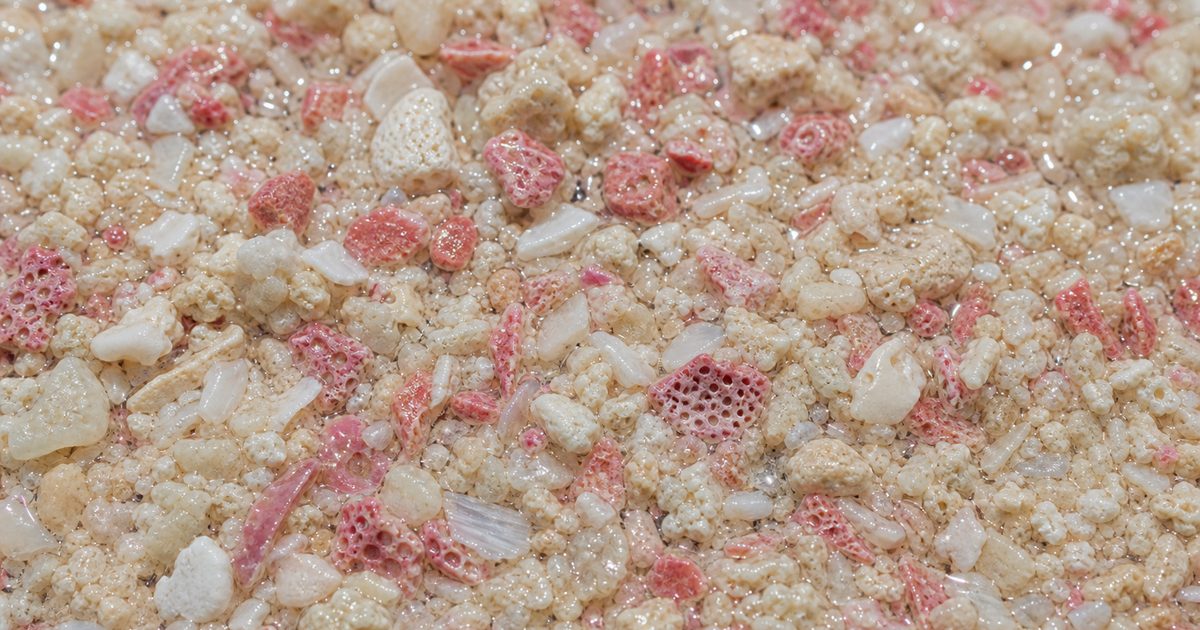
The blush comes from red shell fragments scattered among pale grains. Most are too small to distinguish without a close look. Together, they change the appearance of nearly five kilometers of shoreline.
Pink Sands Beach runs along the Atlantic-facing side of Harbour Island, just off the northeastern coast of Eleuthera in The Bahamas. Known locally as Briland, the island measures about 5.6 kilometers long; its pink shoreline extends for roughly 4.8 kilometers, or three miles.
Those dimensions describe the beach but reveal little about its making. The explanation lies in the reef habitat offshore, where a small, attached organism builds a red skeleton. Its remains eventually become part of the sand.
The red beneath the pink
The organism most closely associated with the color is Homotrema rubrum, a species of foraminifer. Foraminifera, often called forams, are single-celled organisms, many of which build protective structures known as tests. These function much like shells.
This species produces a hard, reddish calcium carbonate test. Although the organism is single-celled, its encrusting growths can become large enough to see without a microscope. “Microscopic organisms” is a useful shorthand for the beach’s origin, but it can obscure that distinction.
On Caribbean reefs, H. rubrum grows attached to hard surfaces. It favors sheltered places such as cavities, the undersides of coral rubble and other shaded reef surfaces. The source of the beach’s conspicuous color spends its life largely out of sight.
After the organism dies, its test can remain attached for a time or enter the surrounding sediment. Physical disturbance and abrasion break the red material into smaller pieces. Some of those fragments eventually reach the shore.
They do not arrive alone. Pale particles derived from shells, corals and other carbonate-producing marine organisms make up much of the surrounding sand. Dispersed through that lighter material, the red fragments register as pink.
The distinction is important: the grains are not all pink. Nor does a mineral stain coat the whole beach. Its color emerges from a mixture, much as a small amount of a strong pigment changes the appearance of a pale background. Look closely enough, and the apparent uniformity gives way to separate particles.
A beach made from marine remains
Many familiar beaches contain abundant quartz, weathered from continental rocks and carried toward the coast. Harbour Island belongs to a different sedimentary setting. Across much of The Bahamas, marine organisms provide the raw material for carbonate sand.
A shell begins as a structure made by an animal or another organism. Once abandoned, it becomes a particle subject to currents, abrasion and burial. Its biological identity becomes less obvious as it breaks apart.
The red foram fragments follow that same route. Their contribution happens to remain visible because of their color.
There is no single moment when this material becomes a beach. Fragments may spend time on the seabed, move during energetic weather, settle again and later travel farther shoreward. Other particles remain offshore. The sand at the water’s edge represents a selection of material that waves and currents have transported and sorted.
That makes the shoreline an accumulation rather than a solid geological body. Its grains have different origins and different histories, even when they lie beside one another.
A handful of sand can therefore contain evidence of several kinds of marine life. Most of those remains lend the beach its pale background. The red fragments attract attention because they alter what the eye sees at a much larger scale.
What the reef contributes
The reef’s first contribution is habitat. Suitable hard surfaces allow Homotrema rubrum to grow, supplying red skeletal material as successive organisms live and die.
Its second contribution concerns water movement. Offshore reefs and shallow banks alter incoming waves before they reach the beach. Waves lose energy as they encounter shallow ground and break, changing how sediment moves nearer the shore.
This does not turn the eastern coast into a motionless basin. It faces the Atlantic, and wave action remains central to the beach’s formation. Water transports particles, wears down fragments and rearranges the shoreline.
The reefs around northern Eleuthera and Harbour Island include the Devil’s Backbone, a name associated with the area’s shallow, hazardous reef passages. It is better to understand these features as parts of a wider coastal setting than to credit one named reef with producing the entire beach.
Nor does shelter guarantee that every grain stays put. A reef can modify wave energy without preventing erosion. Storms, currents and seasonal conditions continue to move sand along the coast and between the beach and seabed.
The offshore environment thus influences the shore in two distinct ways: it supports organisms that contribute sediment, and it changes the forces acting on that sediment. The pink beach depends on their interaction, rather than on shell production alone.
Why the color seems to disappear
A visitor expecting a saturated pink ribbon may initially see a pale beach with only a suggestion of rose. That does not make the color artificial. It makes the photographs an unreliable measure of its intensity.
Moisture changes the way light travels through sand. Wet grains generally scatter less light back toward the eye, allowing their colors to appear darker and richer. Along the swash line, where waves repeatedly soak the surface, the reddish component can become easier to distinguish.
Dry sand scatters more light and often looks much paler. The boundary between wet and dry ground can make the same beach appear to have two different colors.
Sun angle, cloud cover and the direction of view also matter. Low light may bring warmth to the scene, although there is no guaranteed hour when the beach reaches a particular shade. Camera exposure, white balance and editing introduce further differences.
The mixture itself need not look identical everywhere. Moving water sorts sediment according to properties including particle size, shape and density. Local concentrations can vary as the shore shifts.
What looks like a change in the beach’s identity is often a change in viewing conditions, surface moisture or the distribution of its grains. The strongest pink may occupy a narrow wet strip rather than the whole expanse.
The sand’s pale color also reflects a substantial amount of sunlight. That can help limit heating compared with darker sand, but claims that it always stays cool go too far. Surface temperature still depends on sunlight, moisture, weather and the time of day.
A continuing supply, an uncertain balance
The beach contains the remains of past marine life while receiving and exchanging sediment through present-day processes. Yet “continually replenished” should not be mistaken for “impossible to deplete.”
Production and retention are different matters. Organisms can add skeletal material offshore while currents carry other sediment away. A beach remains broad only when its overall sediment balance allows it.
Reef health matters within that balance. Damage can change habitats, biological communities and the physical structure that affects waves. Warming seas, coral bleaching and other pressures threaten reef ecosystems, though their consequences for a particular beach are not simple to predict.
It would be too neat to say that damaged coral immediately means paler sand. H. rubrum occupies reef-associated surfaces, and its response depends on local conditions. Existing red fragments may also remain in the sediment after the organisms that produced them have died.
Predicting a change in color would require evidence about those populations, sediment supply and coastal transport. The connection to the reef is real; the timetable and visible outcome are less certain.
This distinction gives conservation a more substantial basis than preserving a photogenic shade. Protecting marine habitat helps maintain the processes that generate and move the material of the shore. Avoiding damage to reefs and dunes also respects a coast that supports an inhabited island, not merely a visitor attraction.
Leaving sand in place is a small, practical part of that approach. Collected as a souvenir, it becomes a static object in a bottle. At the waterline, the same grains remain available to the next wave.
FAQ
What makes Harbour Island’s sand pink?
Red skeletal fragments, especially those of the foraminifer Homotrema rubrum, mix with pale carbonate sand. The combined material gives the shoreline its soft pink appearance.
Is Pink Sands Beach really pink?
Yes, but the natural color is often delicate rather than vivid. Wet sand can show a stronger blush, while dry areas may appear almost white. Highly saturated photographs can exaggerate the effect.
How long is Pink Sands Beach?
It stretches for approximately 4.8 kilometers, or three miles, along Harbour Island’s eastern, Atlantic-facing coast.
What does the coral reef have to do with the sand?
Reef habitats support organisms that produce some of the beach’s sediment, including red forams. Offshore reefs also modify wave energy, influencing how that material moves and accumulates.
Can you take pink sand home from Harbour Island?
Leave the sand on the beach rather than collecting it. Check applicable local rules, and do not assume that a small quantity is exempt from environmental or customs restrictions.