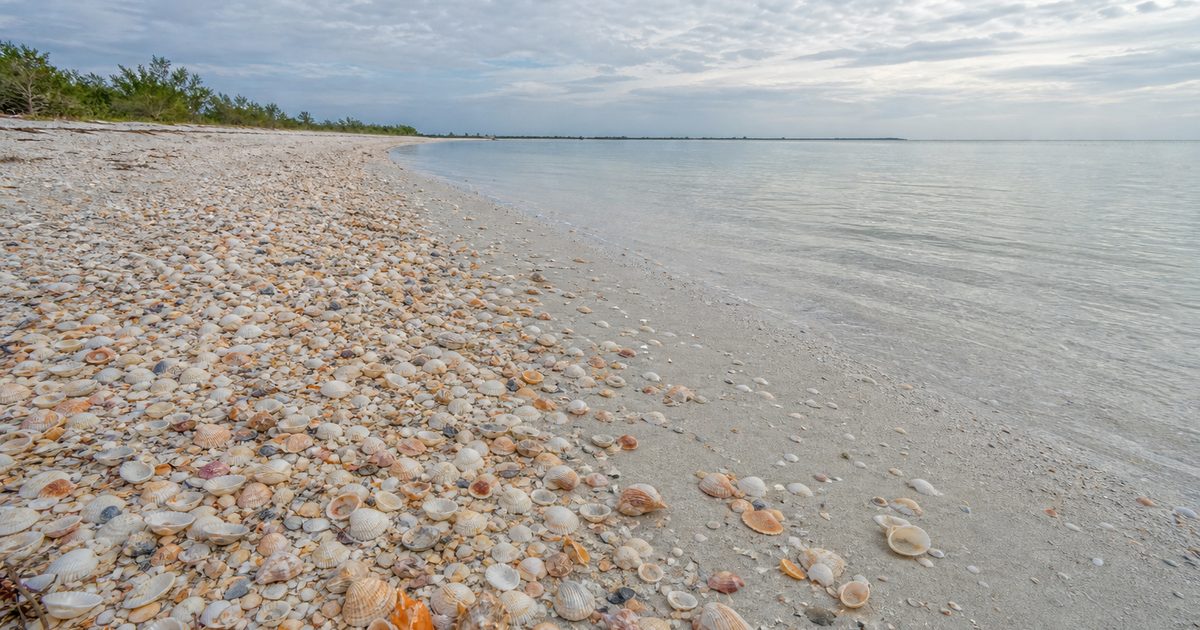
Bent at the waist, eyes on the wash line, people on Sanibel move in a posture so familiar it has its own name. The Sanibel Stoop looks comic until you watch the beach for a while. Then it makes sense. This island catches shells in unusual numbers, and the proof lies underfoot.
That reputation is often compressed into a slogan, but the real explanation is more interesting. Sanibel is a small barrier island on Florida’s Gulf Coast, about 19.3 kilometers long and only 3.2 to 4.8 kilometers wide, with an average elevation of roughly 1.2 meters above sea level. Its fame as a shelling beach comes less from chance than from shape: the angle of the shoreline, the broad shelf offshore, and the way Gulf currents meet land here instead of slipping past it.
The coast that catches
Most of Florida’s barrier islands run north to south. Sanibel does not. It lies east to west, and that single fact explains much of its shell story.
Waves and currents in the Gulf of Mexico meet the island broadside. On many coasts, water moves along the shore and carries light debris with it. Here, the island interrupts that movement. Shells, sand, and other material drifting in the water are more likely to be pushed toward the beach and dropped there. People often compare Sanibel to a scoop or a dustpan. The image is simple, but it gets at the point: the shoreline is positioned to gather.
The seafloor helps. Offshore lies a wide, gently sloping shelf rather than a quick drop into deeper water. That shallower profile slows the energy of incoming water. It also gives shells more chances to be lifted, shifted, sorted, and finally left on the sand. A steeper coast tends to lose material into depth. Sanibel keeps more of it in play.
The island itself formed over thousands of years through the accumulation of sand and shell material moved by Gulf currents. That origin matters because it links the present beach to the same long process that built the island in the first place. Sanibel is not simply a place where shells arrive. It is a place made, in part, by their accumulation.
What washes ashore
A shell on the beach is the hard remnant of a mollusk, and Sanibel receives them in striking variety. More than 250 species have been documented on the island; some counts place the total higher, into the 250 to 400 range. Even allowing for differences in how such lists are compiled, the diversity is real.
Common finds include Florida fighting conchs, lettered olives, lightning whelks, tulip shells, calico scallops, giant cockles, pen shells, transverse ark, ponderous ark, coquina, ceriths, and the odd cemented spirals of worm snails. Those names can sound like a catalog until you see them where the tide leaves them: the smooth gloss of an olive, the fan ribs of a scallop, the heavy hinge of a cockle, the long dark blade of a pen shell.
The Gulf side of southwest Florida also supports mollusks whose shells tend to be larger and, in some cases, more vividly patterned than beachcombers expect from temperate coasts. That helps explain why a walk here can feel less like casual beachcombing and more like close looking. The beach rewards patience.
Then there are the finds that become stories. The Junonia, Scaphella junonia, is the shell collectors talk about in lowered voices. It is rare enough on Sanibel to carry a kind of local mythology, though not mythology in the literal sense: people do find them, just not often. Lion’s Paw shells and Scotch Bonnets belong to the same category of celebrated discoveries, the sort that can turn an ordinary morning into a tale repeated for years.
Timing matters more than luck
Abundance alone does not explain a good shelling day. Timing does.
Low tide is usually best, especially in the hour before and after it, when the freshest line of deposition is easiest to read. At high tide, much of that evidence sits underwater or is blurred by wave action. At low tide, the beach shows its recent history more clearly.
Weather can change everything. Winter cold fronts and tropical storms often stir offshore shell beds and push new material onto the beach. That does not make storms benign; on a low barrier island, they are destructive forces. But it does mean the same event that erodes dunes or damages infrastructure can also rearrange the shell line overnight.
Moon phases play a part as well. Full moon and new moon tides can expose more beach and shift more material. For anyone interested in Sanibel shelling, the lesson is simple: the beach is not static. It is a moving record of wind, tide, current, and recent weather.
That is why shell seekers scan the tideline with such concentration. They are not just looking down. They are reading what the sea did in the last tide cycle.
The Sanibel Stoop as local culture
The Sanibel Stoop is a joke, but only partly. It is also a technique shaped by the island itself.
On shell-rich stretches such as Bowman’s Beach, Blind Pass, and the beaches near the lighthouse, people slow to a near shuffle, bent forward, eyes fixed on wet sand and shallow wash. The posture has become one of the island’s best-known images because the beach keeps rewarding it. A shoreline that offers little teaches people to stroll upright. Sanibel teaches them to stoop.
Over time, that habit turned into culture. The Sanibel Shell Festival, held in early March, is widely described as the longest-running and largest shell show in the world. The Bailey-Matthews National Shell Museum extends the same fascination indoors. It is the only museum in the United States devoted solely to shells and mollusks.
These institutions matter because they show how a coastal quirk became a local identity. The island did not just accumulate shells. It built rituals, expertise, and public memory around them.
Before collectors, the Calusa
Long before tourists came looking for a perfect Junonia, shells on Sanibel had practical and social value. The Calusa, the Indigenous people who dominated much of southwest Florida, used shells as material rather than keepsake.
They built mounds and middens from shell deposits. They made tools and ceremonial objects from them. They also engineered waterways, including canals in the region, as part of a society closely adapted to estuaries, fisheries, and coastal resources. On Sanibel and nearby areas, shell was infrastructure.
That history needs careful telling. The Calusa were not quaint predecessors to modern shell collectors, and their shell use was not a hobby on a grand scale. It was part of a complex coastal society. In what is now the J.N. “Ding” Darling National Wildlife Refuge, Calusa shell mounds remain visible in the landscape, a reminder that the island’s shell abundance supported human life long before it supported tourism.
Accounts of the Calusa often compress centuries into a few lines. What matters here is the distinction: the same shoreline that now invites beachcombers once sustained a people who understood shells as building material, technology, and daily necessity.
A beach with rules
A coast known for collecting shells also needs limits. On Sanibel and nearby Captiva, Lee County regulations prohibit taking live shells, live sand dollars, sea stars, and sea urchins within a half-mile of shore. The penalties can be serious: a first offense may bring a $500 fine or up to 60 days in jail.
In the waters of the J.N. “Ding” Darling National Wildlife Refuge, the rules are stricter. Shell collecting there is prohibited, including empty shells. That can surprise visitors, but the logic is clear. Protected waters are not an extension of the souvenir hunt.
The island’s conservation framework is broader than shell rules alone. More than 70 percent of Sanibel’s natural land, over 4,856 hectares or 12,000 acres, is protected. The Sanibel-Captiva Conservation Foundation, founded in 1967, is the island’s largest private landowner and protects more than 850 hectares on Sanibel, along with additional land in the region. Its work includes monitoring sea turtles, shorebirds, water quality, seagrass, mangroves, aquatic wildlife, and harmful algal blooms.
That context matters because shells do not arrive in isolation. They are part of a living coastal system. A shell beach exists because mollusks live offshore, because seagrass beds and water quality support marine life, and because enough of the shoreline remains ecologically functional to keep the cycle going.
Seasonal darkness matters too. During sea turtle nesting season, from April 15 to November 1, keeping beaches dark helps prevent disorientation of nesting turtles and hatchlings. Even a beach famous for what it leaves behind must be managed for what still comes ashore alive.
After storms, the pattern persists
Sanibel is low, exposed, and vulnerable. Hurricane Ian made that plain, and recovery has continued in stages. Access to some beaches and parking areas can change as repairs continue. Yet the larger shell story remains the same because the forces behind it remain the same.
At the east end of the island, the Sanibel Lighthouse, first lit on August 20, 1884, still marks a coast where shell seekers search the tideline. In the refuge, Calusa shell mounds still show an older relationship between people and marine remains. At the shell museum, beach finds are placed back into the larger world of mollusks and coastal ecology.
Sanibel’s population was 6,382 in the 2020 U.S. Census, rising seasonally with visitors. That pressure is real. So is the fragility of a barrier island with little elevation. But the reason people keep bending over the beach has not changed. Currents meet an east-west shore. Waves cross a broad Gulf shelf. The sea sorts, carries, and deposits. What remains on the sand is not random treasure. It is the visible result of geography.
FAQ
Why is Sanibel Island famous for shells?
Because its east-west orientation and broad offshore shelf help trap shells carried by Gulf currents and waves, leaving unusual numbers on the beach.
What is the Sanibel Stoop?
It is the bent-over posture shell collectors use while scanning the tideline for shells on Sanibel Island.
What is the best time for Sanibel shelling?
Low tide is usually best, especially within an hour before or after. Cold fronts, storms, and full or new moon tides can also bring in fresh shells.
Can you take live shells on Sanibel?
No. Live shells, live sand dollars, sea stars, and sea urchins are protected under local regulations, and violations can bring fines or jail time.
What rare shells can be found on Sanibel Island?
The Junonia is the best-known rare find. Lion’s Paw shells and Scotch Bonnets are also prized by collectors.