A coco de mer can weigh as much as 30 kilograms. That fact tends to eclipse everything around it. Yet the palm that drops that giant seed grows on islands whose deeper strangeness lies underfoot: old continental granite standing alone in the Indian Ocean, far from any mainland. In Seychelles, the famous seed is only the most visible clue.
The archipelago covers a small land area, 452 square kilometres across 115 islands, but it sits within a vast maritime space. Many of those islands are uninhabited. Some are coral. The inner group, though, is something rarer: granitic islands that do not fit the usual oceanic script. Their geology shaped the habitats that allowed species to evolve in isolation, and that same isolation delayed permanent human settlement until the colonial era. To understand why Seychelles feels so singular, it helps to begin with the rock.
Granite in deep water
Most islands in the Indian Ocean are volcanic or coral-built. Seychelles is different at its core.
Mahé, Praslin, La Digue and Frégate are made of granite that dates to roughly 748 to 755 million years ago, in the Neoproterozoic. These islands belong to a microcontinent once lodged between Madagascar and India within Gondwana. When that ancient supercontinent broke apart, this sliver of continental crust was left stranded in the ocean.
That point matters because the landscape of Seychelles is not the product of a typical mid-ocean island chain. It is continental rock, isolated by deep water. The breakup happened in stages. East Gondwana began to fragment about 120 million years ago, separating Antarctica-Australia from Madagascar-Seychelles-India. Later, around 85 million years ago, Madagascar-Seychelles-India split further as the Mascarene Basin opened. What remained was the Seychelles microcontinent, detached but not erased.
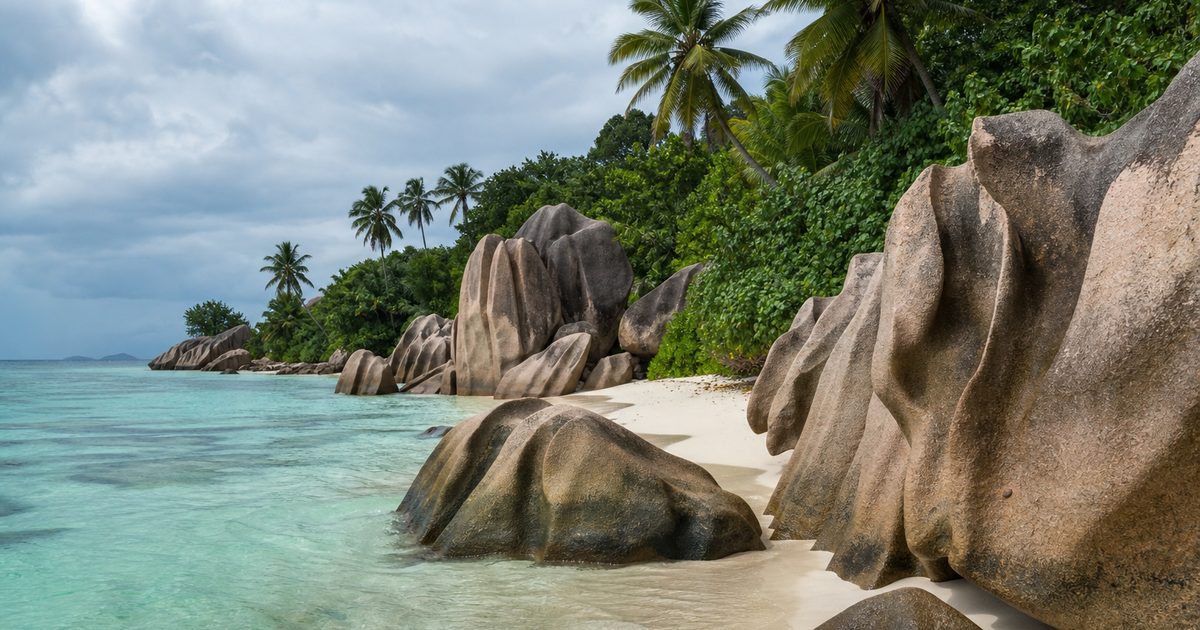
You can still read that history in the shape of the land. Granite hills rise abruptly from the sea. Slopes break into rounded boulders and exposed slabs. On Mahé, Morne Seychellois reaches 905 metres. On La Digue, the stone at Anse Source d’Argent has been weathered into smooth, pale masses that look almost fluid until you touch them. The forms can seem theatrical, but they are the slow result of tropical weathering acting on very old rock.
Geologists have also noted doleritic dykes cutting through the granite, trending roughly west-northwest to east-southeast. Those intrusions belong to later phases in the islands’ long geological history. They are not what most visitors notice first. What people notice is the improbable fact of granite itself: a continental fragment exposed in the middle of the ocean.
Claims about uniqueness need care, but this one is central to any account of Seychelles geology. The archipelago is widely described as the only mid-ocean island group of continental granite. That is the foundation on which the rest of the story stands.
Isolation written into the living world
Old rock alone does not produce biological distinctiveness. Distance does the rest.
Once separated from surrounding landmasses, the islands became laboratories of constraint. Fewer arrivals meant fewer competitors, fewer predators, and fewer ecological roles to fill. Species that managed to establish themselves adapted to local conditions and, over long spans of time, diverged into forms found nowhere else. Endemism in Seychelles is not an ornament to the landscape. It is one of the main consequences of isolation.
The best-known example is the coco de mer, Lodoicea maldivica, native only to Praslin and Curieuse. Its seed is the largest in the world, reaching about 30 kilograms. That is a precise distinction, not a romantic one. For centuries, the nuts drifted far from where they grew, and before their source was understood, people imagined they came from underwater forests. The name “coconut of the sea” preserves that older belief. It is tradition, not botany, but it shows how the species entered Indian Ocean lore long before it was properly described.
The palm is famous for good reason, yet it can distort the wider picture. Seychelles also holds a set of endemic plants that are less known and no less telling. Nepenthes pervillei, the Seychelles pitcher plant, traps insects in modified leaves. Vanilla phalaenopsis, the Seychelles wild vanilla orchid, is a rare climber with salmon-red flowers. The islands also support a remarkable concentration of endemic plant lineages, including genera such as Glionnetia, Medusagyne, Nephrosperma, Northia, Phoenicophorium and Roscheria. Their presence points to long isolation and survival in restricted habitats.
The same pattern appears in the fauna. On La Digue, the Seychelles black paradise flycatcher, Terpsiphone corvina, survives in a narrow range of woodland and is known locally as the vev. It remains one of the archipelago’s most vulnerable birds. The Seychelles blue pigeon, Alectroenas pulcherrimus, belongs to the granitic islands as well. So do the Seychelles sunbird, Cinnyris dussumieri, the Seychelles kestrel, Falco araeus, the Seychelles magpie-robin, Copsychus sechellarum, and the Seychelles warbler, Acrocephalus sechellensis.
Some of the most revealing species are easy to miss. The Seychelles scops owl, Otus insularis, was long feared lost before its rediscovery in 1959. Endemic frogs include the Seychelles tree frog, Tachycnemis seychellensis, Gardiner’s frog, and the Seychelles dwarf frog. There are dozens of endemic snails. Reptiles include geckos such as Phelsuma astriata and Ailuronyx tachyscopaeus, along with skinks and the Seychelles wolf snake.
Aldabra lies apart from the granitic inner islands, and its ecology belongs to a different geological setting, but it belongs to the same wider national story of isolation. The Aldabra giant tortoise, Aldabrachelys gigantea, survives there in large numbers under strict protection. Some individuals exceed 250 kilograms and can live well beyond a century.
What links all these species is not simply rarity. Their scarcity follows from the same conditions that made the islands geologically unusual: separation, bounded habitats, and time. In Seychelles, evolution worked with a limited cast and a very long stage.
A late human arrival
The human history of Seychelles is short when set against the age of the land. That contrast is one of the archipelago’s defining facts.
There was no indigenous settled population before the colonial period. The islands were known within the wider Indian Ocean world, and scholars have suggested earlier Arab or Austronesian contact. Arab navigators were likely aware of them by the 7th century CE, and coco de mer circulated in trade. But awareness is not the same as settlement. What is firmly established is that permanent habitation came much later.
Vasco da Gama sighted the islands in 1502. The first recorded European landing followed in January 1609, when the English East India Company ship Ascension reached them. Formal possession came under France in 1756, when the islands were claimed and named after Jean Moreau de Séchelles, the French finance minister.
The first sustained settlement began on 27 August 1770 on St. Anne Island. It was small and unequal from the start: 15 white settlers, 8 Africans, and 5 Indians. Those numbers matter because they show how Seychellois society began, through colonial enterprise, coerced labour, and movement across the sea. This was not an empty Eden receiving pioneers. It was a plantation colony taking shape within the circuits of empire.
Control shifted during the wars between France and Britain. On 16 May 1794, the British frigate Orpheus took Mahé, and Seychelles surrendered. The islands formally passed to Britain under the Treaty of Paris in 1814. They remained a dependency of Mauritius until 1903, when they became a separate Crown Colony. Independence came on 29 June 1976.
That compressed history helps explain the cultural texture of the islands. Seychellois identity formed without a precolonial settled base, through encounter and hierarchy, adaptation and creolization. The population descends from people of African, European and Asian origin. Seychellois Creole emerged as a language of everyday exchange in that mixed and unequal world, alongside English and French, which remain official languages.
For a place so often framed through beaches and scenery, this history deserves plain speaking. The making of Seychelles involved empire and forced labour as well as trade and migration. Its culture is not ancient in the sense some travellers expect. It is comparatively recent, maritime, and deeply shaped by the Indian Ocean.
Where geology and history meet
It is tempting to separate the story into neat compartments: rocks, wildlife, people. On these islands, that division misses the point.
The granite core determined the form of the inner islands. Their isolation limited which plants and animals could arrive, survive and diversify. The same isolation also meant that permanent human settlement came late and by sea. Everything begins with separation. The archipelago’s natural history and human history move on different timescales, but they are responses to the same geography.
Even local legends reflect that setting. Stories of pirate treasure, especially those attached to Olivier Levasseur on Mahé, belong to the islands’ place in maritime imagination. Tales of spirits guarding buried wealth or of strange beings seen offshore are part of the folklore of sea routes and anchorages. They should be treated as legend, not evidence. The same goes for stories that explain island shapes through love affairs, curses or metamorphosis. They are not geology. They are human attempts to answer a landscape that seems to ask for explanation.
That may be why Seychelles leaves such a strong visual impression. The islands look composed rather than merely formed. Granite domes, narrow valleys, heavy seeds, birds with tiny ranges: each element feels specific, almost overdetermined. But the effect comes from long processes, not from mystery.
What still survives
The old continental core remains easiest to grasp in the inner islands. On La Digue, the granite at Anse Source d’Argent gives a clear view of the weathered stone that defines so much of the archipelago’s image. On Mahé, Morne Seychellois National Park protects the highest ground and part of the vegetation that still covers it. On Praslin, the Vallée de Mai preserves one of the best-known coco de mer forests under close protection.
That protection matters because rarity is fragile. Endemic species evolved in systems that are easily disrupted. Habitat loss, invasive species and development pressure can do outsized damage on islands with small ranges and simplified ecological webs. The vev on La Digue survives in just such a constrained setting. Aldabra, far to the southwest, remains strictly protected for similar reasons. Its remoteness is not an invitation to intrusion but part of what has allowed its ecosystem to persist.
Tourism is central to the economy of Seychelles, and that creates a permanent tension. The islands’ distinctiveness draws visitors; the same distinctiveness can be eroded by overuse. Conservation, then, is not a decorative add-on to the national image. It is a practical response to the fact that the most characteristic features of the archipelago are also the least replaceable.
A fragment of Gondwana, a palm with the world’s heaviest seed, a bird surviving in a patch of woodland on La Digue: these are not separate curiosities. They are parts of one island story, written first in stone and only later in human time.
FAQ
Why is Seychelles geologically unusual?
Because its inner islands are made of ancient continental granite rather than the volcanic rock or coral more typical of oceanic archipelagos. They are remnants of the Seychelles microcontinent, once linked to Gondwana.
What is the coco de mer?
The coco de mer, Lodoicea maldivica, is a palm native only to Praslin and Curieuse. It produces the largest seed in the world, which can weigh up to 30 kilograms.
Are there animals found only in Seychelles?
Yes. Endemic species include the Seychelles black paradise flycatcher, the Seychelles scops owl, the Seychelles tree frog, several geckos, and many plants and snails restricted to the islands.
When did people first settle Seychelles permanently?
The first sustained settlement began on 27 August 1770 on St. Anne Island, under French colonial rule.
Was Seychelles inhabited before Europeans arrived?
There was no indigenous settled population before the colonial era. The islands were likely known to earlier navigators, including Arab seafarers, but permanent settlement came much later.