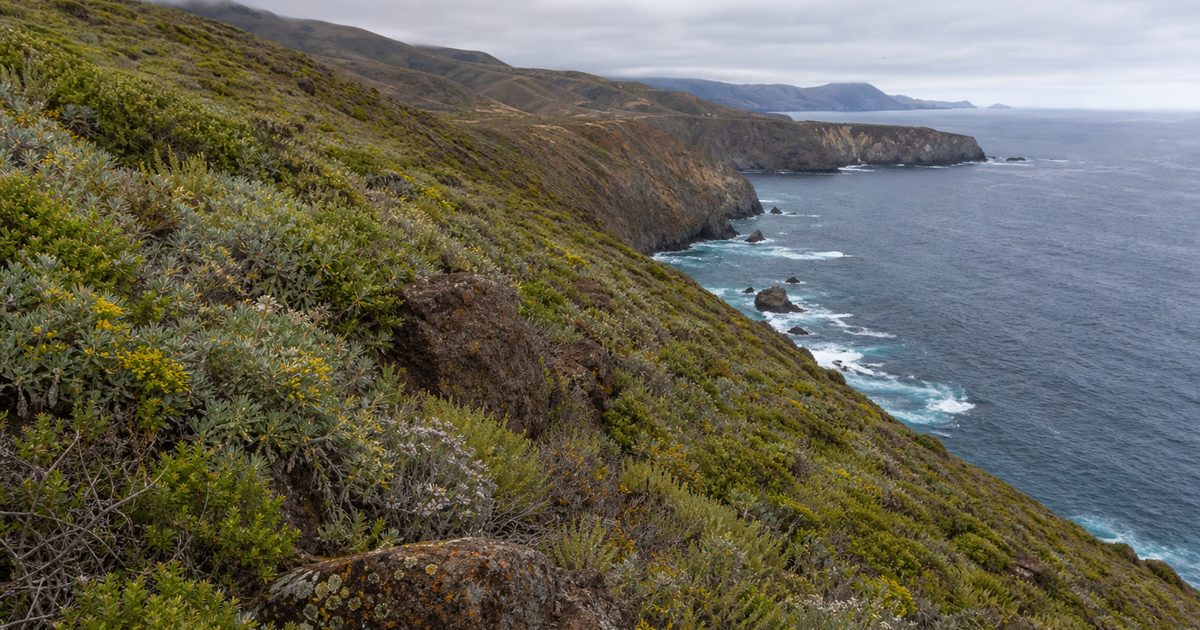
A fox that weighs little more than a domestic cat moves through the scrub on Santa Cruz Island. That small body tells a very large story. On the Channel Islands off Southern California, separation did not simply shelter life from the mainland. It changed it.
That is the core of Channel Islands National Park. The park spans five islands, Anacapa, Santa Cruz, Santa Rosa, San Miguel, and Santa Barbara, and protects a fragment of coast that has long been cut off, reshaped, rejoined, and cut off again. The result is one of the sharpest examples in North America of what isolation can do. Species arrived rarely, populations split, and over time some became distinct enough to exist nowhere else. The comparison to the Galápagos is common enough to sound like tourism copy, but here it points to a real biological pattern.
More than 2,000 species of plants and animals have been recorded on the islands and in surrounding waters, and 145 are endemic. The numbers matter, but the mechanism matters more. This is not abundance for its own sake. It is evolution made visible.
Isolation, but never still
It helps to picture the islands not as fixed dots off the California coast, but as moving pieces in a long geological argument. Shorelines shifted with sea level. Cliffs rose. Land eroded. The northern islands rotated over millions of years as tectonic forces worked on the region. Isolation here was real, but it was never simple.
That instability shaped who could get in, who stayed, and who became stranded. Some mainland relatives reached the islands and found open ecological space. Others never arrived. Once populations were separated by water, they adapted to island conditions: fewer predators, fewer competitors, different food sources, different terrain. Given enough time, those differences accumulated.
Plants show this especially well. Of the 621 native plant species recorded on the islands, about 137 are endemic, roughly 22 percent. That is a high concentration in a small archipelago. It suggests not just preservation, but divergence: lineages staying long enough in one place to become their own.
This is why the phrase “Galapagos of North America” persists. Used lazily, it flattens the place into a slogan. Used carefully, it describes a process. Long separation, small landmasses, ecological opportunity: those are the ingredients.
When four islands were one
The most important chapter in that process begins when the map looked different. During the last Ice Age, lower sea levels joined San Miguel, Santa Rosa, Santa Cruz, and Anacapa into one larger northern island, known as Santarosae. That configuration lasted until rising seas, around 10,000 years ago, broke it apart.
This matters because colonization and isolation did not happen in one step. A species that managed to reach Santarosae did not face four separate crossings. It reached one larger target. Once there, it could spread across a broader landscape. Later, as sea level rose and channels opened, those once-connected populations became isolated from one another.
That sequence helps explain a recurring pattern in the archipelago: close relatives shared across islands, but with local differences that sharpened over time. It also helps explain one of the most striking fossil records in the park. Pygmy mammoths lived on Santarosae during the Pleistocene. Adults stood only about 1.2 to 1.8 meters tall, far smaller than their mainland ancestors. Their bones remain one of the clearest examples here of island dwarfism.
The islands did not create evolution. They made its outcomes easier to read.
The fox that became an island animal
No species carries that lesson more clearly than the island fox, Urocyon littoralis. It weighs about 1.8 to 2.7 kilograms and is the smallest fox in North America. It is also found only on the Channel Islands.
Its size draws attention first, but the finer point is subdivision. Island foxes occur on six islands, and each island population is recognized as its own subspecies. Even within one archipelago, stretches of water were enough to separate one lineage into six local forms. That is isolation working at close range.
The fox is often treated as a mascot, but it is better understood as evidence. A mainland gray fox ancestor reached the islands, then changed under island conditions. Smaller size likely reflected the pressures and opportunities of limited territory and limited resources. On islands, large bodies are often expensive.
The recent history of the species also belongs in the story. Island fox populations crashed in the late twentieth century on several islands, largely because of predation by golden eagles and broader ecological disruption linked to human-introduced animals. Recovery efforts were intensive. Captive breeding, relocation of golden eagles, reestablishment of bald eagles, and removal of feral pigs on Santa Cruz all played a role. The fox’s recovery was substantial enough that it was later removed from the federal endangered species list. That success does not change the deeper lesson. It shows how quickly an island system can unravel when outside pressures enter a tightly balanced ecology.
A jay that went the other way
If the fox is the classic case of shrinking on an island, the island scrub-jay shows the opposite pattern. Aphelocoma insularis, found only on Santa Cruz Island, is larger than its mainland relatives. This is one of the park’s clearest examples of island gigantism.
The contrast matters because island evolution is not a single rule. Isolation does not always make animals smaller. It changes the pressures acting on them. In some cases, reduced competition or altered feeding roles can favor larger size. The point is not that islands produce one predictable result. The point is that they produce departures.
Other animals deepen the same pattern. The island deer mouse, island night lizard, and island spotted skunk all reflect long separation from mainland populations. They are not curiosities lined up in a cabinet. Taken together, they show an archipelago where water repeatedly turned ordinary dispersal into evolutionary experiment.
Plants as records of long separation
The flora tells a quieter version of the same story. Endemic plants do not usually become symbols in the way foxes do, but on the Channel Islands they may be the stronger evidence. Plants cannot leave when conditions change. They persist, adapt, or disappear.
Species such as island paintbrush, Santa Cruz Island dudleya, and island bedstraw are tied closely to these offshore landscapes. Their distributions reflect the islands’ soils, exposure, moisture patterns, and long separation from mainland gene flow. Endemism in plants is often where island history becomes most legible.
Then there is the Torrey pine on Santa Rosa Island, a relict population of Pinus torreyana. “Relict” is a precise word here. It means a surviving remnant of a once broader distribution, not a botanical oddity for its own sake. Such populations can preserve evidence of older climatic and geographic conditions. On an island, that kind of persistence is especially telling. It suggests that while coastlines shifted and habitats contracted, some lineages held on in pockets where conditions remained suitable.
The Channel Islands are sometimes imagined as biologically rich because they are mild and scenic. That misses the point. Their richness comes from constraint, variation, and time.
The rock beneath the biology
The evolutionary story rests on geology. The islands occupy a tectonically active margin shaped by the interaction of the Pacific and North American plates. Over millions of years, the northern Channel Islands rotated clockwise by roughly 100 degrees. Volcanic activity between about 19 and 15 million years ago covered much of the northern islands in thick lava flows.
Their bedrock preserves a complicated past: Miocene volcanic rocks, Eocene and Miocene sedimentary units, and on Santa Cruz Island, older Jurassic metamorphic and intrusive igneous rocks. None of this is backdrop. Rock type influences soil. Soil influences vegetation. Topography controls drainage, exposure, and shelter. Those conditions shape habitat, and habitat shapes selection.
Later uplift and repeated sea-level change carved marine terraces, sea caves, arches, and steep coastal margins. Those features are often described as scenery first. They are better read as evidence. Every terrace marks an older shoreline. Every cave and eroded cliff records a coast that did not stay put. For island species, that meant habitat expanding, shrinking, fragmenting, and reconnecting over long spans of time.
Isolation, in other words, was produced by moving land as much as by surrounding water.
The sea as barrier and engine
Water separated the islands from the mainland, but it also fed the system. The surrounding ocean sits where cool, nutrient-rich waters and warmer coastal influences meet. Upwelling drives high productivity, which supports kelp forests, fish, marine mammals, and seabirds.
That marine richness matters to the islands’ land story. Productive seas support nesting colonies, scavengers, nutrient transfer, and food webs that connect shore and ocean. The boundary between marine and terrestrial life is not neat here.
The broader protected seascape adds scale. Channel Islands National Park covers the five islands and nearby waters, while the Channel Islands National Marine Sanctuary extends six nautical miles around the islands. Within that zone are kelp forests, haul-out sites for seals and sea lions, and feeding grounds used by dolphins and whales.
Seabirds make the connection especially clear. The islands provide crucial nesting and feeding habitat for seabirds in Southern California, including the only major breeding colony of the California brown pelican in the western United States. The same water that kept populations apart also sustained the ecosystems in which they specialized. Barrier and engine at once: that is the central paradox.
Human history in an “isolated” place
The islands were never empty. Archaeological evidence places Chumash presence on the islands at least 13,000 years ago, and the Tongva are also connected to this archipelago. Any account of isolation that treats the place as a pure natural laboratory leaves out a large part of its history.
In Chumash tradition, Limuw, now called Santa Cruz Island, is a place of origin. That belongs in the story as tradition, not as a scientific claim, because the islands have always been cultural landscapes as well as ecological ones. People crossed these channels, lived with their constraints, and understood these places long before they became a national park.
That perspective also sharpens the meaning of “remote.” Offshore does not mean unknown. It means separated in specific ways, at specific times, for specific communities and species.
What isolation still looks like
The striking thing about Channel Islands National Park is that the process remains visible. The fox still carries the mark of dwarfism. The island scrub-jay still shows enlargement on Santa Cruz. Endemic plants still hold to slopes and terraces shaped by old rock and salt wind. Fossils of pygmy mammoths still point back to Santarosae, the lost larger island that made later separation possible.
Even the landforms read like a record of repeated division. Sea caves on Santa Cruz Island, natural arches on Anacapa, marine terraces on several islands, and the eroded walls of places such as Lobo Canyon on Santa Rosa all show a coast in motion. The scenery is dramatic, but the deeper interest lies in what it explains.
Conservation has altered the recent chapter without erasing the older one. Recovery efforts helped restore species including the island fox, peregrine falcon, bald eagle, and California brown pelican. Protected waters now include marine reserves and marine conservation areas where fishing and harvest are restricted or prohibited. That framework matters because island systems are unusually vulnerable. Their distinctiveness is the product of long separation; their losses can happen quickly.
Off one of the most populated stretches of the United States, the Channel Islands still show how distance changes life. Not in theory. In bodies, bones, feathers, seeds, and shorelines.
FAQ
Why are the Channel Islands called the Galápagos of North America?
Because long isolation produced many endemic species and clear examples of island evolution, including dwarfism in the island fox and pygmy mammoths.
What is Santarosae?
Santarosae was the single larger landmass formed when lower sea levels connected San Miguel, Santa Rosa, Santa Cruz, and Anacapa during the last Ice Age.
What animals are found only on the Channel Islands?
The best-known example is the island fox, but the archipelago also has endemics such as the island scrub-jay, island night lizard, and several island plant species.
How many Channel Islands are in the national park?
Five islands are part of Channel Islands National Park: Anacapa, Santa Cruz, Santa Rosa, San Miguel, and Santa Barbara.
Were the Channel Islands inhabited before the park existed?
Yes. Chumash people lived on the islands for at least 13,000 years, and the Tongva also have long-standing connections to the archipelago.