Three miles of harbor is not much on a map. On Peaks Island, it has been enough to shape settlement, schooling, defense, politics, and the daily habit of getting home.
That short crossing to Portland explains more about the island than any postcard view. Peaks Island has never been fully remote, and never fully mainland either. Its history turns on movement across Casco Bay: who could cross, how often, in what season, and under whose protection. Ferries made ordinary life possible. Fortifications made the harbor matter to people far beyond the island. Together, they produced a place that has long been tied to Portland and stubbornly distinct from it.
Before the boats ran on schedule
Long before a Portland to Peaks Island ferry ran by timetable, the islands of Casco Bay formed part of Wabanaki seasonal life. Wabanaki people hunted, fished, and gathered here over a long span of time. That older use matters because it places the island inside a much deeper coastal geography, one based on movement, knowledge of tides and seasons, and repeated return rather than permanent isolation.
The first recorded English landing on the island came in 1623, when Christopher Levett noted his arrival. In the decades that followed, the island passed through a series of colonial names tied to possession and family connection. In 1637, Michael Mitton took a 60-year lease on what was then called Pond Island from George Cleeve, and it became Michael’s Island. In 1661, Mitton’s widow conveyed it to John Phillips; after that it was known as Munjoy’s Island for Phillips’s son-in-law, George Munjoy. Around 1670, it appeared as Palmer’s Island, after John Palmer, another relation by marriage.
Those shifting names tell a blunt story. The island was being absorbed into English colonial property systems. That process was unstable and violent. Munjoy built the Stone House, and during the Wabanaki attacks of 1675-1676, in the wider conflict known as King Philip’s War, the house was attacked. Sources do not settle every detail of the Munjoy family’s fate, and it is better to leave that uncertainty visible than to smooth it into legend.
By the late 17th century, European settlers had established fishing and farming communities. The name Peaks Island is generally understood to derive from the early settler John Peaks. Even then, the island’s life depended on connection to the mainland port. It sat close enough to be governed with Portland, then Falmouth, but far enough away that transport would decide almost everything.
The crossing becomes a system
A small island becomes a community in stages. One clue is the first schoolhouse, opened in 1832 and used as a meeting house for church sermons as well. That shared room suggests a place still building its institutions carefully, asking one structure to do several jobs.
The larger change came on the water. In the 19th century, regular steamboat service began to reorganize life in Casco Bay. The Peaks Island Steamboat Company was formed in 1871 to provide service to Portland. By 1878, the Casco Bay Steamboat Company had begun permanent year-round service to the islands.
That phrase matters more than it first seems to. Summer service can support visitors. Year-round service supports a society.
Once crossings became dependable in every season, Peaks Island could sustain more than seasonal occupation. Families could plan around mail, freight, school, worship, and work. News arrived on a rhythm. Goods did too. So did the practical expectation that bad weather or winter would complicate life, but not suspend it altogether.
The route worked in the other direction as well. Reliable boats did not just hold residents in place. They opened the island to outsiders, and that changed its economy. By the 1880s, Peaks had become known as the “Coney Island of Casco Bay,” a nickname tied to Greenwood Gardens and the island’s growing amusement culture. Hotels, dance halls, and theaters followed. The ferry to Peaks Island was not simply transport. It was the mechanism that made the island available as spectacle.
That dual role never disappeared. The same boat could carry groceries, workers, schoolchildren, and day-trippers. Peaks Island became a neighborhood and an excursion ground at the same time.
Harbor defense in plain sight
The harbor itself also acquired a military reading. Between 1858 and 1864, Fort Gorges was built in the water between Portland and Peaks Island to defend Portland Harbor. Constructed of granite during the Civil War era, it belongs to a period when coastal defense was meant to be fixed, visible, and imposing.
Fort Gorges did not stand on Peaks Island, but it shaped the same corridor of movement. Anyone crossing the harbor moved through a defended approach. The fort made a simple point in stone: Casco Bay was not only a scenic inlet or commercial route. It was an entrance worth guarding.
The fort was officially decommissioned in 1903 and transferred to the city of Portland. Even in disuse, it kept its presence. Today, Fort Gorges still sits in the harbor as a reminder that the waters around Peaks Island have long been understood in strategic terms. Its current preservation problems, including erosion and structural decline, add another layer to the story. A structure built to command the bay now depends on care to survive within it.
Resort crowds, resident routines
The resort era can make it easy to misread Peaks Island as a place remade for visitors. That is too simple. Tourism altered the island, but it did not erase resident life. It sat on top of it.
In the late 19th century, the island’s reputation spread well beyond Portland. Victorian buildings, entertainment venues, and summer hotels gave rise to the “Coney Island of Casco Bay” label, and sometimes the grander “Coney Island of the North.” Yet behind the amusements, year-round residents still had to solve ordinary island problems: schooling, worship, freight, governance, and winter travel.
The history of the boat companies shows that tension clearly. In 1919, the Casco Bay and Harpswell Steamboat Company shut down, and Casco Bay Lines formed that winter. In the late 1920s, the company began shifting its fleet from steam to diesel. Technology changed, ownership changed, and the business model changed, but the service had to continue because island life required it.
The mail route says even more. Casco Bay Lines’ Mail Boat run dates to the 1870s and is often described as the longest-running mailboat service in the country. Even if that claim is best treated with a little caution unless fully sourced, the underlying fact is plain enough: repeated, routine crossings held the bay communities together. The glamour of the resort years mattered less, in the long run, than the ordinary reliability of boats carrying letters, food, fuel, and people who needed to be somewhere by morning.
Battery Steele and the wartime island
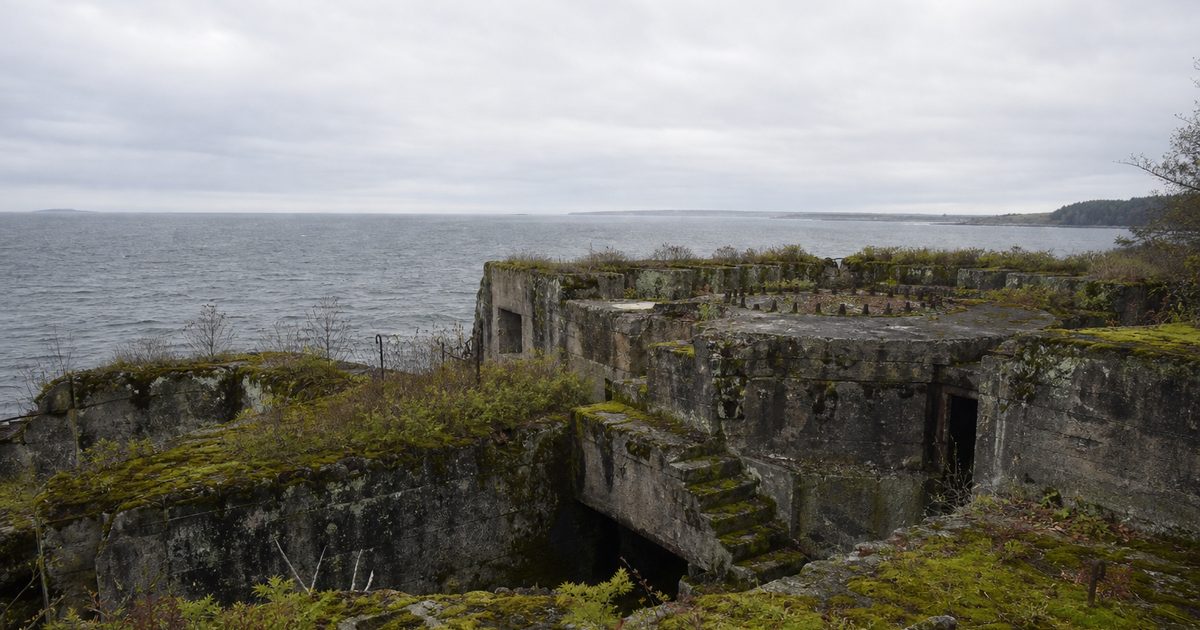
Then the harbor’s strategic logic became impossible to miss. In 1942, Battery Steele was completed on Peaks Island as part of the World War II defense system for Portland Harbor. Armed with two 16-inch guns, it was among the largest coastal gun batteries built in the United States.
That scale can sound abstract until it is brought back to the island itself. During the war, Peaks Island hosted more than 800 soldiers. Military installations spread across a place that was already inhabited, already social, already dependent on the same crossing that had long defined it. The reservation was separated by fences and military rules, but it was not sealed off from local life. Islanders worked on construction. Soldiers joined dances and other social events. The military presence imposed boundaries, yet it also created new forms of contact.
That is the key to understanding Battery Steele. It was not dropped into an empty landscape. It was inserted into a functioning island community.
One local detail captures the scale better than any technical specification. The battery’s 16-inch guns were test-fired only once. The blast broke windows across the island, and the recoil reportedly shook the ground hard enough to feel like small earthquakes. In that moment, military engineering stopped being distant policy and became a physical fact in people’s houses.
Wartime memory also attracts legend. One island story holds that a German U-boat captain spent the war watching Peaks Island through a periscope. As tradition, it belongs to the atmosphere of vigilance that coastal communities often remember after war. It should stay in that category. The story is revealing as memory, not as settled fact.
What remained after the guns
When the war ended, the military role receded, but the infrastructure did not vanish. That matters because Peaks Island has often absorbed old systems rather than wiping them away.
In 1995, the Peaks Island Land Preserve was formed to buy and protect the Battery Steele area as public land. In 2005, Battery Steele was added to the National Register of Historic Places. A restricted military zone became part of the island’s public historical landscape.
The same pattern appears in civic life. Island Hall, the first school built in 1832, was torn down in 1959. Yet education remained rooted in older structures. Peaks Island Elementary School still operates in a historic 1869 building. On a small island, institutions tend to accumulate in place. They are adapted, repurposed, argued over, and carried forward.
The ferry system followed a similar path. In 1981, the Casco Bay Island Transit District was established to secure continued service. Casco Bay Lines now runs every day of the year, with frequent service between Portland and Peaks Island. The crossing takes about 20 minutes, a short trip that still governs work schedules, school routines, deliveries, appointments, and the simple question of whether one can get back before weather turns.
Closeness, in other words, is not the same as ease. The island is near Portland because the route exists and keeps existing.
A place tied to Portland, and apart from it
Peaks Island is officially part of the City of Portland, Maine, but the water has always sharpened its separate identity. The island has tried multiple times to secede from Portland. Even without rehearsing each attempt in detail, the pattern is telling. Dependence on the city and distance from it are experienced at the same time.
That tension received formal recognition in 2007, when the Portland City Council authorized the elected Peaks Island Council to advise on island matters. The arrangement acknowledged a practical truth: a neighborhood reached by ferry does not experience city government in quite the same way as one reached by road.
Seen this way, the island’s history is not really a tale of ferries on one side and forts on the other. They belong to the same structure. The crossing made everyday life possible. The fortifications made the crossing politically and militarily important. Together they explain why this small piece of land in Casco Bay developed such a strong sense of itself.
The evidence is still there if you know how to read it. Fort Gorges remains in the harbor. Battery Steele still dominates part of the island with its concrete mass. The Fifth Maine Museum preserves parts of the local past, including the Fifth Maine Regiment’s Civil War battle flag. The boats still come and go on schedule. Every arrival repeats the old fact that has shaped Peaks Island for centuries: three miles of water can bind a place to a city, and keep it distinct from that city at the same time.
FAQ
How long is the ferry to Peaks Island?
The trip from Portland takes about 20 minutes on Casco Bay Lines.
Is Peaks Island part of Portland, Maine?
Yes. Peaks Island is officially part of the City of Portland, though it has a strong local identity of its own.
What is Battery Steele?
Battery Steele is a World War II coastal fortification on Peaks Island, completed in 1942 to help defend Portland Harbor.
Why was Peaks Island called the “Coney Island of Casco Bay”?
In the late 19th century, regular boat service helped turn the island into a popular summer resort with amusements, hotels, dance halls, and theaters.
Can you visit Fort Gorges from Peaks Island?
Fort Gorges sits in Portland Harbor between the island and the mainland. It is separate from Peaks Island, but it belongs to the same history of harbor defense.