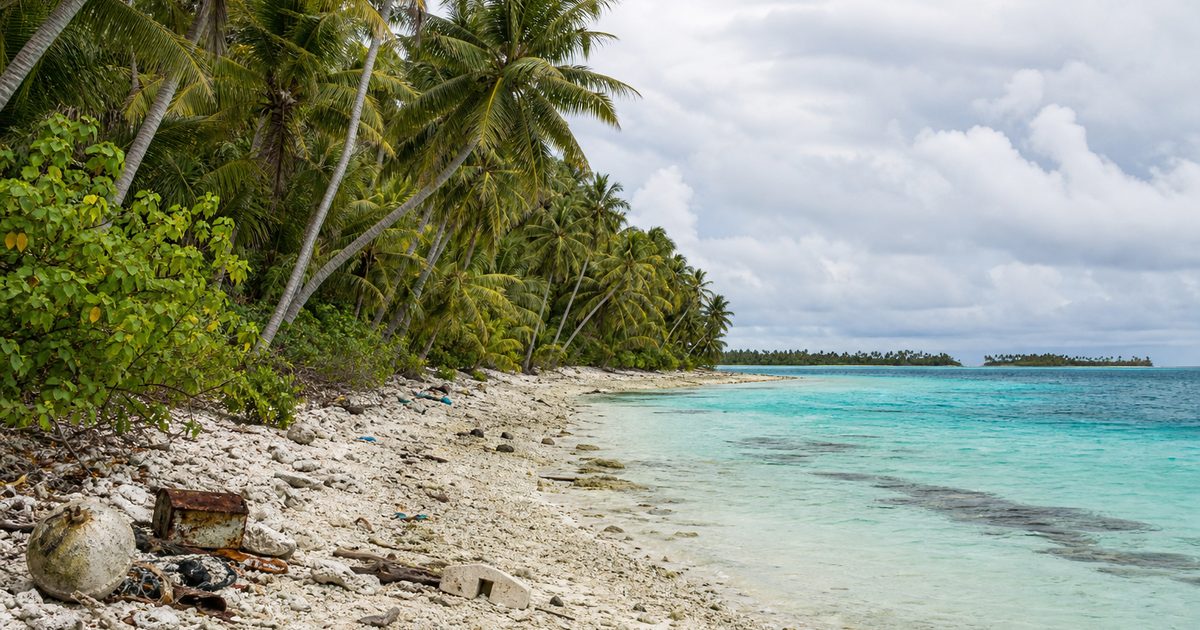
Pisonia trees rise roughly 15 meters above Nikumaroro, spreading a green canopy over an island that could not reliably supply its residents with drinking water. Coconut palms crowd stretches of the shore. Seabirds nest above ground patrolled by large crabs. Seen from a ship, the atoll gives little warning of thirst.
That contrast shaped the history of this small island in Kiribati’s Phoenix archipelago. A British colonial settlement began here in 1938. About a hundred people lived on the atoll by the mid-1950s, but recurrent drought helped end the project. The settlement was abandoned in 1963, and residents relocated to the Solomon Islands.
Nikumaroro is better known for a disputed possibility: that Amelia Earhart and Fred Noonan reached it after disappearing in 1937. Yet the documented experience of its residents poses a question worth considering on its own. What does it take to survive on an island whose vegetation promises more than its freshwater can deliver?
What the trees cannot tell you
Nikumaroro, formerly known as Gardner Island, stretches about 7.5 kilometers around an elongated lagoon. Its narrow strips of coral land total roughly four square kilometers. There are no permanent residents.
Freshwater behaves differently on a coral atoll than it does on a mountainous island. There are no upland catchments feeding streams downhill. Rain infiltrates porous ground, and some may accumulate as a freshwater lens above denser saltwater. The lens is not an underground lake with fixed boundaries. Its extent and salinity respond to rainfall, extraction and the surrounding sea.
A prolonged dry spell can therefore change the practical meaning of “water available.” A well may still contain water while becoming too brackish to drink.
Trees do not offer a dependable measure of that supply. Their roots, water requirements and tolerance of local conditions differ from those of a household drawing drinking water every day. A forest can persist where a village struggles.
The surrounding ocean presents a similar contradiction. Fish and other marine resources can provide food, but they cannot replace freshwater. On this atoll, the distinction between ecological abundance and human habitability was not theoretical. It affected where people could live, what they could cultivate and whether they could remain through a drought.
A colonial settlement built around coconuts
Nineteenth-century commercial ventures treated remote Pacific islands as potential sources of export commodities. Nikumaroro attracted attempts at coconut cultivation before the more sustained settlement of the following century. Palms remain conspicuous, but their presence says little about whether those enterprises succeeded.
The British initiative that brought Gilbertese settlers in late 1938 formed part of the Phoenix Islands Settlement Scheme. Colonial administrators sought to establish communities on several islands, partly in response to population and land pressures elsewhere in the Gilbert and Ellice Islands Colony.
Coconut cultivation offered an apparent economic foundation. Copra, the dried flesh of the coconut, could enter established trading networks. The plan nevertheless depended on something less easily shipped or sold: enough dependable water for the people producing it.
The settlers made homes, worked plantation land and built a community. Their history deserves more than the phrase “failed colony,” which reduces years of domestic life and labor to an administrative outcome. Karaka village, also rendered Karake in accounts of the island, left physical traces of that occupation.
By the mid-1950s, the population had reached approximately a hundred. These were not castaways surviving for a few days. They were residents attempting to maintain ordinary lives through repeated periods of scarcity.
Drought exposed the settlement’s vulnerability. Coconut trees could not make the freshwater lens dependable, and an export crop could not remove the need for safe drinking water. The eventual departure was a relocation of people with homes and attachments, not simply the closure of a plantation.
Survival left several kinds of evidence
Before the settlers arrived, Nikumaroro had already become a refuge under very different circumstances.
In November 1929, the British freighter Norwich City ran onto the reef. Eleven crew members died. Survivors reached the island and awaited rescue, leaving the wreck as a conspicuous landmark on the western reef.
Their ordeal establishes that shipwrecked people did reach this atoll. It does not establish how another group, arriving under different conditions, would have fared. Injury, supplies, rainfall and the location of a landing could all alter the prospects of survival.
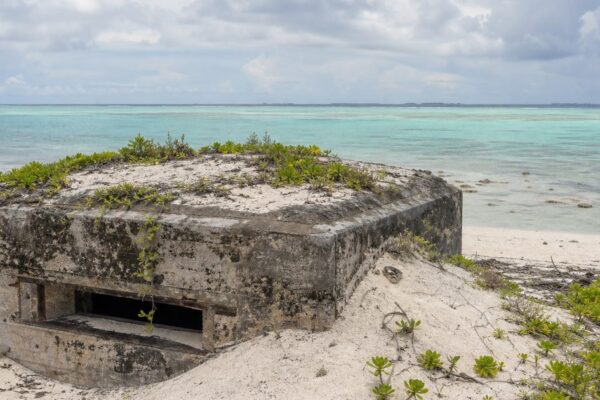
Later occupation added further material. During the Second World War, the United States Coast Guard operated a LORAN radio-navigation station on Nikumaroro. This was not an airbase: descriptions of a wartime airstrip confuse the island’s military history.
The distinction matters because physical traces underpin so many claims about the atoll. Shipwreck debris, settlement objects and military equipment do not belong to a single episode. A piece of metal or glass may be genuinely old without having any connection to a missing aircraft.
Even an improvised object needs context. Who could have made it? What materials were already available? Could waves, later visitors or residents have moved it? On a small island with several periods of occupation, proximity alone cannot answer those questions.
Earhart’s possible landfall
Amelia Earhart and navigator Fred Noonan disappeared on July 2, 1937, while attempting to reach Howland Island during their round-the-world flight. What happened after their last radio transmissions remains unresolved.
One explanation is that their aircraft exhausted its fuel and came down at sea. The Nikumaroro hypothesis proposes that they instead reached this atoll, landed on its reef and survived ashore for a time.
The island’s environmental history gives that proposal a credible setting for hardship. It does not supply evidence that the landing occurred.
Timing also matters. Earhart and Noonan disappeared before the Gilbertese settlement began. If they reached the island, they would not have found the community established the following year. Nor can the later settlement’s difficulties tell us exactly what water or supplies would have been available to two stranded people in July 1937.
A community must sustain many people across seasons. Castaways face a different calculation, shaped by what they carry, their physical condition and how long they must wait for rescue. The colony’s eventual abandonment illustrates the severity of the freshwater problem without reconstructing the aviators’ fate.
That separation is essential. Otherwise, a documented environmental difficulty becomes a substitute for evidence of a particular event.
The bones and the limits of identification
In 1940, a discovery of human bones on Nikumaroro prompted an investigation. Associated finds included shoe remains and a sextant box. These objects later became central to arguments that Earhart had died on the island.
A physician examining the bones in 1941 concluded that they belonged to a man. Decades later, researchers revisited the surviving measurements and questioned that assessment.
A forensic study published in 2018 argued that those measurements were more consistent with Earhart’s estimated body proportions than with most individuals in a reference sample. The result attracted considerable attention, but it was not an identification.
The original bones have been lost. Researchers cannot re-examine them using modern skeletal methods or attempt DNA testing on the remains themselves. They must work with historical measurements, descriptions and assumptions about how accurately those records represent the skeleton.
The disagreement is therefore more substantial than a simple correction of an old mistake. Different interpretations depend on the quality and limits of a small surviving dataset.
Shoe fragments present another problem. Even an object compatible with something Earhart might have worn cannot establish that she wore it. The same restraint applies to artifacts recovered during later expeditions. Compatibility can justify further investigation; it cannot, by itself, identify an owner.
Coconut crabs are not a verdict
Coconut crabs, Birgus latro, inhabit Nikumaroro’s terrestrial landscape. These large land crabs also feature prominently in sensational accounts of Earhart’s disappearance.
As scavengers, they raise legitimate questions about what might happen to animal or human remains on the island. But the familiar story that crabs consumed Earhart turns several uncertainties into a narrative that sounds settled.
It assumes she reached the atoll, died there and left remains accessible to scavengers. None of those steps has been conclusively established.
The crabs cannot answer the first question simply because they might help explain the last. Their behavior may inform studies of decomposition and the movement of remains, but it cannot identify an unknown person.
Popular retellings often make the island’s wildlife seem like an explanation for its human losses. The documented settlement history points elsewhere: toward rainfall, groundwater and the difficulty of maintaining a community through drought. Those pressures are less theatrical than giant crabs, but much better established.
Protecting the ground where questions remain
Nikumaroro lies within the Phoenix Islands Protected Area, established by Kiribati in 2006 and expanded in 2008 to approximately 408,250 square kilometers. UNESCO inscribed the protected area on the World Heritage List in 2010.
That designation recognizes an oceanic ecosystem far larger than the atoll’s narrow land surface. Its reefs and seabird habitats have value independent of any aviation discovery. Research must also account for the remains of settlement, shipwreck and military occupation.
Access requires authorization from Kiribati. Permit conditions and expedition requirements should be confirmed with the responsible authorities; an archaeological question does not create a right to land or collect objects.
The shoreline itself continues to change. Erosion, storms and rising sea levels complicate the preservation of sites and the interpretation of objects found near them. A missing artifact may have been washed away. An exposed object may have moved. Neither possibility permits certainty about what once lay there.
For investigators, the task begins before any dramatic identification: record the location, establish the context and leave room for an explanation that has nothing to do with Earhart.
FAQ
Where is Nikumaroro?
Nikumaroro is an uninhabited coral atoll in the Phoenix Islands of Kiribati, in the central Pacific Ocean. It was formerly called Gardner Island.
Why was Nikumaroro abandoned?
Recurrent drought and an unreliable freshwater supply undermined its Gilbertese settlement. The community left in 1963, with residents relocating to the Solomon Islands.
Is there freshwater on Nikumaroro?
Rainfall can replenish groundwater beneath the atoll, but that supply is limited and vulnerable to drought and salinity. Green vegetation does not indicate dependable drinking water.
Did Amelia Earhart land on Nikumaroro?
It remains an unproven hypothesis. Researchers have investigated possible artifacts and historical reports, but no conclusive evidence places Earhart or her aircraft there.
Were Amelia Earhart’s bones found on the island?
Human bones discovered in 1940 have been linked to Earhart by some researchers. Others dispute the interpretation. The bones are now lost, and their identity remains unresolved.