A single radio line has done more than any map to fix Nikumaroro in the public imagination: “We are on the line 157 337.”
Amelia Earhart transmitted those words on 2 July 1937 during the flight that disappeared with navigator Fred Noonan. The numbers refer to a navigational line of position. Extended across the central Pacific, it passes near the atoll once called Gardner Island. That proximity is one reason this narrow ring of coral in the Phoenix Islands of Kiribati has occupied such a stubborn place in the Earhart mystery.
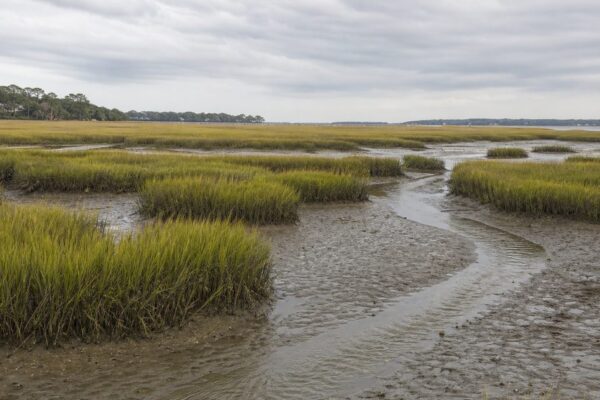
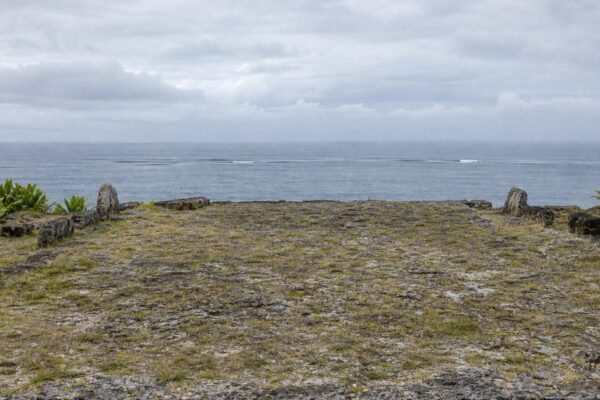
Nikumaroro is small even by atoll standards, about 7.5 kilometers long and 2.5 kilometers wide, with no point much above 6 meters. It lies far from major land, uninhabited now and protected within the Phoenix Islands Protected Area. Access is restricted. Yet this low reef and scrub island has become one of the most argued-over pieces of ground in aviation history, not because it offers many answers, but because it offers just enough.
Why Nikumaroro entered the Earhart case
The case for Nikumaroro begins with geography, not romance.
Earhart and Noonan vanished while trying to reach Howland Island, a tiny target in a vast ocean. The broadest explanation has long been the crash-and-sink theory: they failed to find Howland, ran out of fuel, and went down at sea. The competing Gardner Island hypothesis is more specific. It argues that they missed Howland, followed or searched along the 157/337 line, reached Gardner Island, and landed on its reef.
That theory survives because several different strands point toward the same atoll. Earhart’s last known transmission places her on a line of position that runs close to it. After the disappearance, radio operators in the Pacific and the United States reported signals thought by some to be post-loss transmissions from Earhart. Some direction-finding work on those signals was later interpreted as crossing near Gardner Island.
None of that proves an aircraft reached the reef. The reported signals remain disputed, and the quality of wartime and prewar radio bearings was uneven. Still, this is why Nikumaroro matters. It is not just another remote island onto which a mystery was projected after the fact. It sits near the line Earhart herself reported.
A reef that could receive a plane, then erase it
From the air, a coral reef can suggest possibility. On the ground, or under surf, it becomes a harsher thing.
Nikumaroro’s fringing reef is central to the theory because it may, under the right tidal conditions, have offered a temporary landing surface for a Lockheed Electra. It is also central because such a landing would have been precarious from the start. A plane on a reef flat is exposed to tide, swell, and the constant grinding force that breaks ships apart on coral.
That tension shaped the earliest search. About a week after Earhart and Noonan disappeared, U.S. Navy aircraft flew over Gardner Island and reported no sign of an airplane. For critics of the Nikumaroro theory, that has often seemed decisive. For supporters, it raises a narrower question: if an aircraft did reach the reef, how long would it have remained visible?
On this atoll, timing matters. The landscape looks static on a chart, but it is not static in practice. Reef edge, lagoon margin, shoreline and scrub all shift under weather and water. TIGHAR, the International Group for Historic Aircraft Recovery, founded in 1985, has argued that Earhart’s aircraft could have landed on the reef and then been damaged or carried off by surf before searchers saw it.
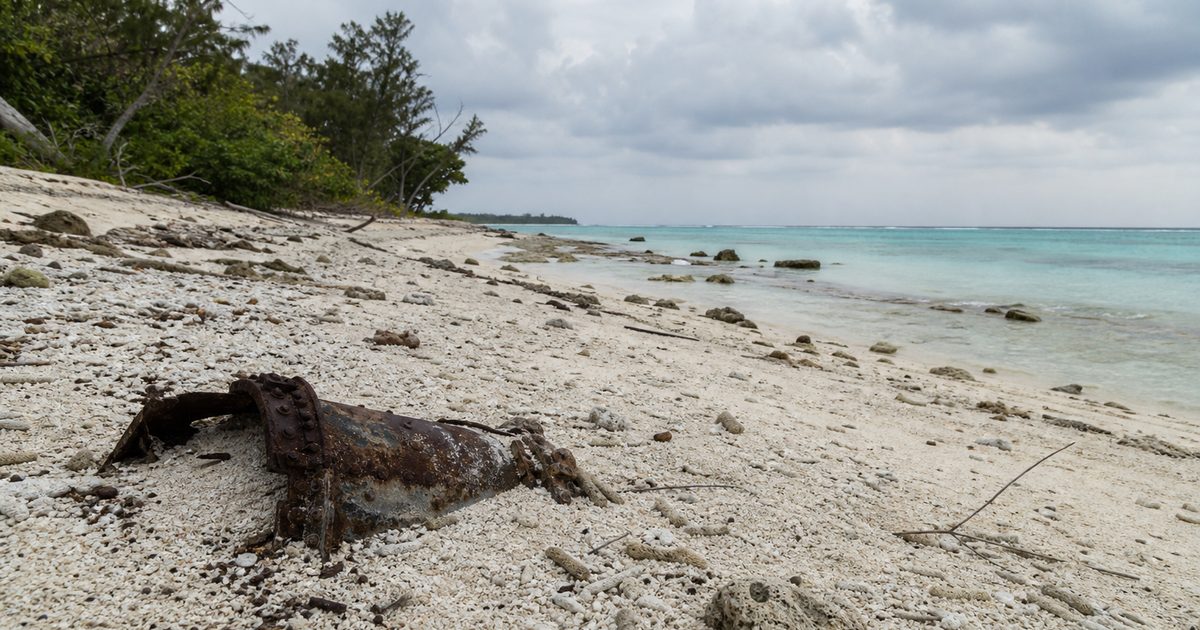
The island offers a blunt example of what surf can do. On 29 November 1929, the British freighter SS Norwich City ran aground on Nikumaroro’s reef. Its wreck remained visible for decades and still marks the place. The ship has nothing to do with Earhart directly, but it does something almost as important: it demonstrates the character of the reef. Metal can arrive here in one form and leave in another.
The 1940 bones and the limits of evidence
The most persistent evidence tied to Nikumaroro did not appear in 1937. It surfaced three years later.
In late September 1940, British colonial officer Gerald Gallagher reported the discovery of a human skull and other skeletal remains on the island’s southeastern side, beneath a tree. Also found nearby were a woman’s shoe, a sextant box, signs of a small fire, and a bottle identified in accounts as Benedictine liqueur. The bones were sent to Fiji for examination and were later lost.
That much belongs to the documentary record. What the find means is another matter.
The attraction of the site is obvious. A remote atoll. Human remains. A campfire that suggests someone lived there for a time rather than simply washed ashore and died. A woman’s shoe that has often been described as American in manufacture and broadly consistent with late-1930s styles. A sextant box that invites comparison with Noonan, though a box is not a sextant, and not every navigational instrument case points to one missing man.
This is where the Gardner Island Nikumaroro theory becomes strongest and weakest at once. Strongest, because the cluster of finds is hard to dismiss as random. Weakest, because each item opens into uncertainty.
The bones themselves are gone. Their original examination in Fiji concluded they were male, though later researchers challenged that reading. In 1998, a re-analysis of the recorded measurements argued that the remains were more consistent with a woman of Earhart’s general build. Supporters of the Nikumaroro hypothesis treat that reassessment as one of the most important developments in the case. Critics answer that any conclusion drawn from old measurements, without the bones, must remain provisional.
The same caution applies to the artifacts. The shoe matters. So does the fire. So does the sextant box. But none of them, alone or together, closes the case. They make Nikumaroro more than a speculative dot on a map. They do not turn it into certainty.
What settlement added, and what it could not preserve
Nikumaroro did not remain empty after Earhart vanished. Under the Phoenix Islands Settlement Scheme, I-Kiribati settlers, often described in colonial records as Gilbertese, were moved there from 1938 until the settlement period ended in the early 1960s. Their presence matters because inhabited places generate memory.
Former residents later spoke of airplane wreckage on the reef flat. One often-cited account concerns Temou Samuela, a carpenter on the island in 1940, who reportedly knew of wreckage there. Such recollections have become part of the evidentiary landscape around Amelia Earhart and Nikumaroro, but they need careful handling. They are memories and reports, not contemporaneous proof. On an island where hard evidence is scarce and the environment destructive, oral history carries weight. It cannot carry the whole argument.
The settlement also clarifies the practical side of the castaway theory. Life on Nikumaroro was difficult even for a planned colony. Fresh water was unreliable. The shallow freshwater lens on coral atolls is vulnerable to drought and salt intrusion. The colony struggled, and the British eventually evacuated the remaining residents to the Solomon Islands in 1963.
That history matters because it strips away fantasy. If Earhart and Noonan reached the atoll, survival for a short period is plausible. Long-term survival would have been another matter. Nikumaroro is not a storybook refuge. It is a place where scarcity defines daily life.
The modern hunt for proof
Since 1989, TIGHAR has mounted repeated expeditions to the atoll, turning Nikumaroro from a footnote in disappearance theories into a sustained archaeological argument. Its teams have searched the reef, the shoreline, the lagoon, and the site associated with Gallagher’s 1940 discovery. Along the way, the organization has helped establish the island as the main terrestrial candidate in the Earhart debate.
That work has also drawn close scrutiny. Interpretations of artifacts, camp traces, and site associations have been challenged by other researchers. This is not unusual in a case built from fragments. Every object on Nikumaroro carries two burdens at once: what it is, and what people want it to mean.
The pattern has repeated across decades. A clue appears. It is tested. It narrows possibilities, or it dissolves under examination, but it rarely settles anything. In that sense, the atoll has shaped the mystery as much as the mystery has shaped the atoll. Coral islands do not preserve evidence the way dry caves or cold water sometimes do. They scatter, abrade, bury, and expose.
A later high-profile search made that plain again. In 2019, an expedition led by Robert Ballard looked for evidence of Earhart’s aircraft around Nikumaroro and did not find it. That negative result mattered, but not in the simple way headlines often suggest. Failure to find wreckage is not proof of absence on a reef system where objects can break up, shift, or sink beyond easy recovery.
Attention has also turned at times toward an anomaly in the lagoon seen in imagery and referred to as the Taraia Object. It has been discussed as possible aircraft wreckage, though discussion is not identification. Until such a target is examined and documented, it belongs in the category of lead, not evidence.
Why this atoll keeps hold of the story
Some places become famous because they yield a decisive object: a wreck, a body, a black box, a signed confession. Nikumaroro has done the opposite. It has remained compelling because it yields partial things.
The atoll still contains visible layers of unrelated history. The wreck of the Norwich City remains on the reef. Settlement traces survive from the colonial period. The island’s ecology, including Pisonia forest, seabird colonies, reef life, and turtles, belongs to one of the largest marine protected areas on Earth. That protected status matters. Nikumaroro is not an open-air treasure hunt. It is a restricted conservation area, and any investigation there has to answer to the place as it exists now, not just to the mystery attached to it.
What makes the island so difficult to dismiss is the way its physical character fits the case. Earhart’s last line of position points near it. Its reef could, at least in theory, have accepted a landing. Its shoreline produced human remains and artifacts in 1940. Its environment is exactly the kind that could destroy an aircraft while preserving only scattered traces.
That is why the Amelia Earhart mystery returns to this one coral atoll again and again. Not because Nikumaroro offers a neat ending, but because it offers a coherent setting. In a disappearance defined by oceanic scale, it reduces the question to something almost painfully specific: one reef, one shore, one lost camp, one set of bones that can no longer be tested.
FAQ
Where is Nikumaroro?
Nikumaroro is a coral atoll in the Phoenix Islands of Kiribati, in the central South Pacific. It is remote, uninhabited, and part of the Phoenix Islands Protected Area.
Why is Nikumaroro linked to Amelia Earhart?
The link comes mainly from Earhart’s final known transmission, “We are on the line 157 337,” because that navigational line passes near the atoll. Later finds on the island, especially the 1940 bones and artifacts, strengthened interest in the theory.
What is the Gardner Island hypothesis?
It is the idea that Earhart and Fred Noonan missed Howland Island, reached Gardner Island, now called Nikumaroro, landed on the reef, and survived there for some time.
Were bones really found on Nikumaroro?
Yes. In 1940, Gerald Gallagher reported a skull and other skeletal remains, along with several associated objects. The bones were sent to Fiji and were later lost, which is one reason the case remains unresolved.
Can people visit Nikumaroro?
Access is restricted. The atoll lies within a protected area, and visits generally require permits for scientific or conservation work.