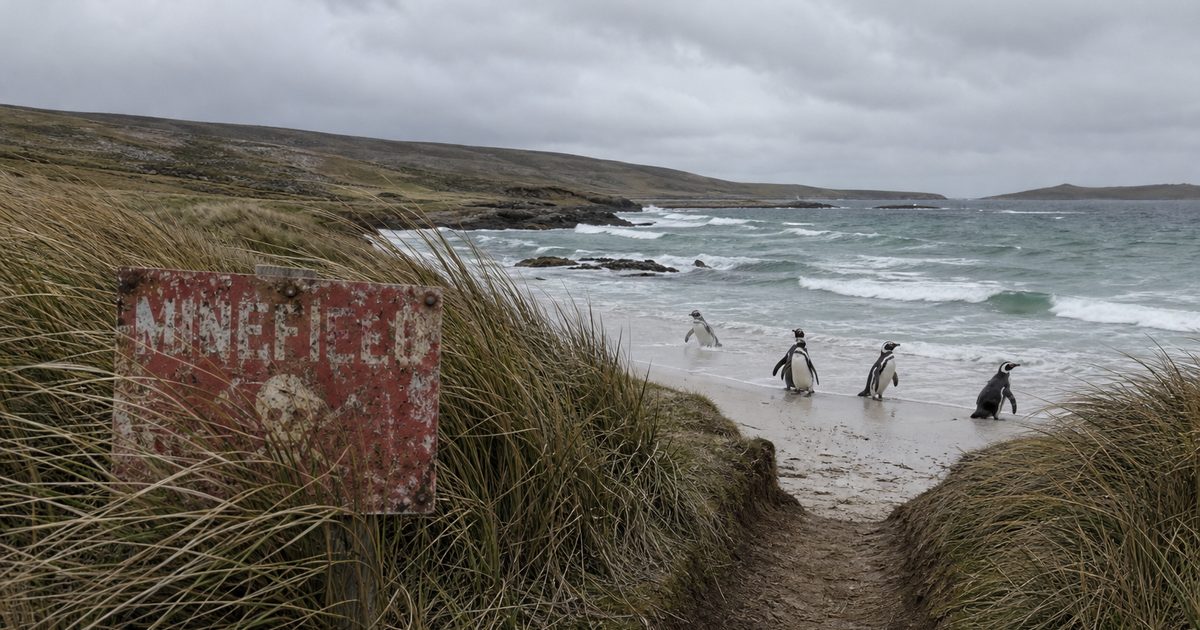
Yellow warning signs once stood between people and penguins.
For decades after the 1982 Falklands War, parts of the Falkland Islands remained fenced off because of buried landmines. Those closed beaches and strips of moorland were dangerous to cross, but they were quiet. In that enforced absence, seabirds bred, grasses recovered, and a strange fact took hold: some of the ground most marked by war became, by accident, a refuge for wildlife.
That is the thread that best explains the islands. The Falklands are often described in separate categories, as a seabird stronghold or as a battlefield in the South Atlantic. The split is misleading. On this archipelago east of Patagonia, ecology and conflict have shaped the same coast, sometimes at the same moment. The last mines are gone now, yet the overlap remains written into the land.
Where exposure favors birds
The Falkland Islands are treeless, wind-scoured and ocean-bound. Their climate is sub-Antarctic and maritime: cool, wet, and rarely still. That exposure, which can make the human settlement pattern feel spare, suits seabirds well. Nutrient-rich waters feed the surrounding seas, and the long coastline offers breeding ground on a scale hard to match.
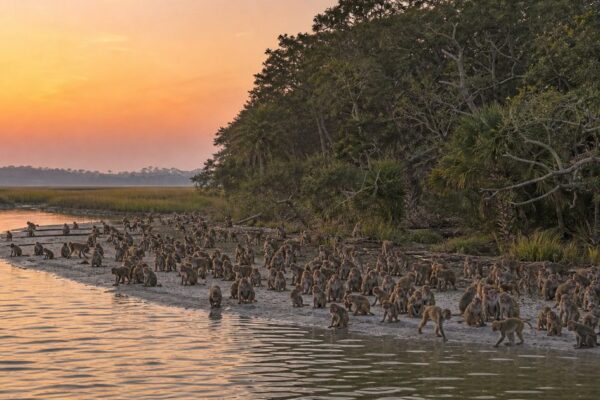
The archipelago consists of 778 islands with a total land area of 12,173 square kilometers. Across them breed 59 bird species. More than a million penguins live on the islands, and five species nest there each year: king, gentoo, southern rockhopper, Magellanic, and macaroni penguins. Gentoo numbers are especially important in global terms. The islands hold about 30 percent of the world population, with more than 100,000 breeding pairs.
Albatrosses are just as central to the picture. The Falklands support some of the largest colonies of black-browed albatross anywhere. Giant petrels patrol the same coasts. So do striated caracaras, still widely known locally as Johnny Rooks, along with rock cormorants and upland geese.
A few birds belong almost entirely to this place. The Falkland steamer duck, Tachyeres brachypterus, is endemic. So is Cobb’s wren. Around the shore, southern sea lions, southern elephant seals, and South American fur seals haul out on beaches, while the surrounding waters support 15 species of whales and dolphins.
This abundance can make the islands seem untouched. They are not. Their wildlife story has always been entangled with human use, extraction, and loss. The clearest older example is the warrah, the Falklands’ only native land mammal, driven to extinction in the 19th century. The more recent example arrived much faster.
The war that altered the ground
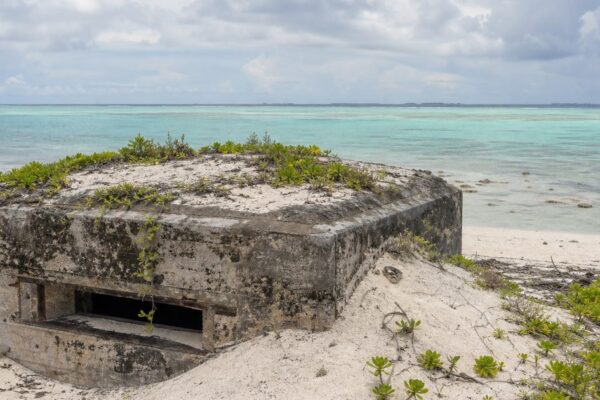
The Falklands War lasted 74 days, from 2 April to 14 June 1982. It was fought between Argentina and the United Kingdom over sovereignty of the islands, a dispute that continues diplomatically long after the shooting stopped.
Its traces were not confined to memorials or military cemeteries. Argentine forces laid about 30,000 landmines, including anti-personnel and anti-vehicle devices, across more than 120 hazardous areas. Many were placed in coastal zones, on beaches, in dunes, and on open ground where people might move on foot or by vehicle. Early British clearance efforts after the war were curtailed after serious accidents. The result was a landscape partitioned for decades.
For islanders, that changed ordinary movement. Fences and warning signs cut across places that had once been part of daily geography. A beach was no longer just a beach. It was a place you remembered through prohibition.
The environment was hit more directly as well. Oil spills from wartime ship losses caused serious local damage, and military activity disturbed habitats. Some studies have suggested that the conflict significantly slowed the growth of king penguin breeding populations. Beyond that, the longer ecological effects remain a matter for study rather than a settled ledger of consequences.
That distinction matters. The war’s environmental impact is not folklore, but neither is every claim about it equally well established. What can be said clearly is that the conflict altered access, breeding space, and patterns of disturbance for many years after 1982.
Minefields as accidental sanctuaries
The paradox at the center of the Falklands is simple and uncomfortable. Landmines made parts of the islands dangerous for people. They also kept people out.
In a place already rich in coastal nesting habitat, exclusion had consequences. Penguins used beaches and shorelines that humans could not enter. Vegetation in some fenced areas grew with less trampling and less routine disturbance. The effect was never universal, and it was never the result of conservation planning. These were hazardous military remnants, not protected areas in any ordinary sense. Still, some former minefields functioned as de facto refuges.
That fact has often been reduced to a neat anecdote about penguins being too light to trigger mines. The reality is broader and more interesting. The key ecological change was not simply that birds could move across mined ground. It was that people could not. Distance, fencing, and caution created a buffer around stretches of coast that might otherwise have seen regular human presence.
This is why wildlife and war memory resist separation on the islands. The same fence could signify fear, grief, inconvenience, and ecological quiet. To a resident, it marked a wound left by conflict. To nesting birds behind it, it marked reduced disturbance. Neither meaning cancels the other.
The Falkland Islands wildlife story is full of such mixed legacies. Cobb’s wren, one of the endemic birds, remains vulnerable to introduced rodents on some islands. The archipelago’s remoteness has not insulated it from human pressure. It has simply given those pressures a particular shape.
Clearing dangerous ground
The mines stayed because removing them was difficult, expensive, and dangerous. The legal obligation came later. The United Kingdom ratified the Anti-Personnel Mine Ban Convention, often called the Ottawa Treaty, in 1998, committing itself to clear mined territory under its control.
A full clearance program ran from 2009 to 2020. The work demanded patience rather than speed. Deminers, many of them from Zimbabwe, worked through beaches, dunes, peat, and moorland in weather that could shift quickly and in terrain that complicated detection and excavation. Devices had aged in the ground. Some had moved. Every site required care.
By November 2020, the Falkland Islands were officially declared mine-free. That announcement closed a chapter that had lasted far longer than the war itself. It was legal, practical, and symbolic at once. It meant the end of a physical danger. It also altered the emotional map of the islands. Places known for warning signs could be entered again, though not stripped of memory.
The Zimbabwean teams deserve a place in that history. Their role was not incidental. They were part of the long human effort that turned fenced ground back into usable land.
What remains after the fences
Mine clearance did not restore some earlier, neutral landscape. It changed access, but it did not erase what access had meant.
That is especially clear in places where war memory and penguin colonies sit close together in the public imagination. The Falklands remain globally important for king, gentoo, southern rockhopper, Magellanic, and macaroni penguins. Black-browed albatross colonies are still among the largest in the world. Southern sea lions, elephant seals, and fur seals still haul out on the same coasts where military danger once kept people back.
Yet the meaning of those shores has shifted. A reopened path carries two histories at once. One is military and political: the unresolved sovereignty dispute, the 74 days of fighting, the decades of warning signs. The other is ecological: years in which some beaches and moorland were less disturbed, and wildlife used that reprieve.
That does not make war a conservation tool. It means only that landscapes do not sort themselves into moral categories as neatly as people do. Damage in one register can produce shelter in another. The Falklands show that with unusual clarity.
The islands are inhabited, economically active, and politically contested. According to the 2021 census, the population was 3,662. Most Falkland Islanders are of British descent, and many families trace their roots back generations. The community also includes people with ties to Saint Helena, Chile, the Philippines, and Zimbabwe. Even names carry tension here: “Kelpers” is used for islanders, but it can be taken as insulting, especially when used by Argentines.
There is a deeper human past as well. No indigenous population was present at the time of European settlement, but archaeological and paleoecological evidence suggests prehistoric human activity by seafaring peoples from Tierra del Fuego, including Yaghan, centuries earlier. The extent of that activity remains under investigation, and it should be described as evidence rather than certainty.
All of this matters because the Falklands are not a museum of war or a wildlife park with a military footnote. They are a lived-in archipelago where sovereignty, settlement, conservation, and memory meet on the same ground.
The last mines are gone. The paradox they created remains one of the most revealing facts about the islands: violence fenced off parts of the coast, and in that exclusion some of the Falkland Islands penguins and other wildlife found temporary shelter.
FAQ
Why were there landmines on the Falkland Islands?
Argentine forces laid about 30,000 landmines during the 1982 Falklands War, across more than 120 hazardous areas, mainly to defend strategic ground.
Are the Falkland Islands mine-free now?
Yes. After a long clearance program, the islands were officially declared mine-free in November 2020.
How did landmines affect wildlife in the Falklands?
Minefields kept people out of some coastal areas for decades. That reduced disturbance and allowed certain birds and vegetation to persist in relative quiet.
What penguins live on the Falkland Islands?
Five species nest annually: king, gentoo, southern rockhopper, Magellanic, and macaroni penguins.
Is the Falklands War still politically relevant?
Yes. The fighting ended in 1982, but the sovereignty dispute between the United Kingdom and Argentina remains unresolved.