At Rano Raraku, a stone figure more than 20 meters long still lies attached to the rock from which its carvers began to release it. Its face has taken shape. Its journey never began.
Known as El Gigante, this unfinished moai exposes something that the standing statues of Rapa Nui can obscure: an immense amount of work separated a figure in the quarry from an ancestor raised above a community. Carvers had to shape the stone, free it, move it across uneven ground and bring it upright without breaking it.
The eyes belonged to the final stage. Some statues received white coral eyes with dark pupils after reaching their ceremonial platforms. The familiar weathered faces once looked quite different.
Rapa Nui, also known as Easter Island, lies roughly 3,500 kilometers west of mainland Chile. Its moai are often discussed as an engineering puzzle. Yet the question of how people moved them makes little sense without another: why did ancestral figures deserve so much collective effort?
The bodies beneath the heads
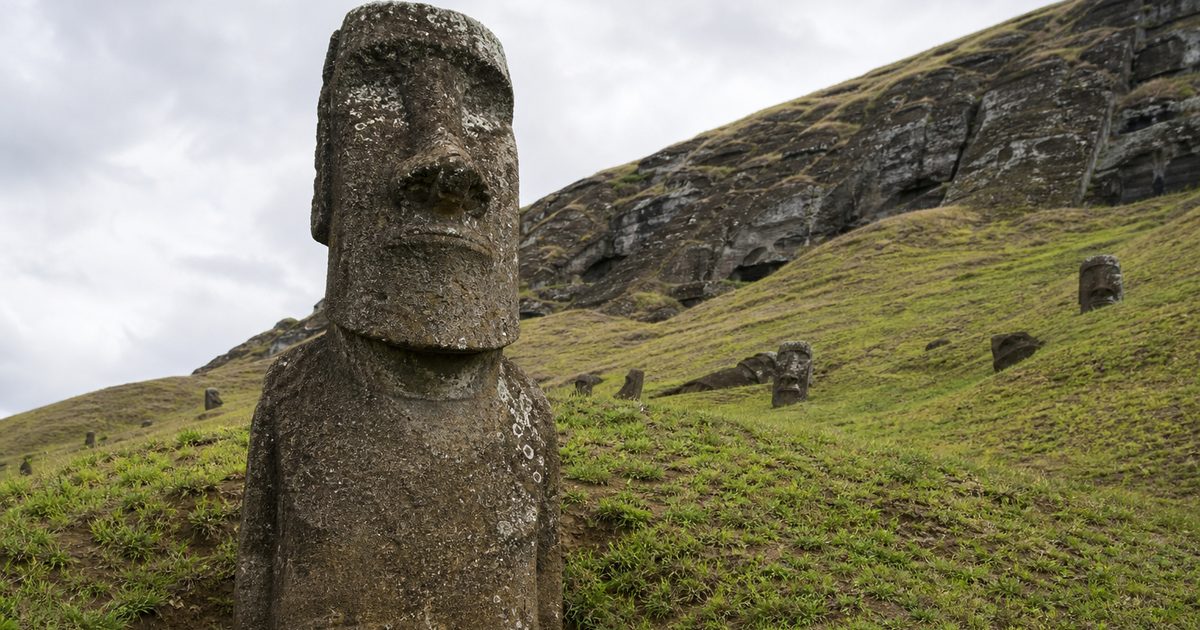
At the quarry, soil has accumulated around many statues, concealing their torsos and leaving their heads above ground. Photographs of these figures helped establish the misleading phrase “Easter Island heads.”
Moai have bodies. Their elongated faces continue into shoulders, arms held close to the sides and hands resting across the lower abdomen. Burial has hidden much of that anatomy at Rano Raraku; it was never absent.
The distinction changes how the sculptures read. These are human figures with a deliberate posture, not faces mounted on stone pillars. Their repeated features established a recognizable ancestral form, though individual statues differ in proportion and detail.
A commonly cited average is about four meters in height and 12.5 tonnes in weight. Larger examples demanded substantially more labor. Paro, generally identified as the tallest moai successfully erected, stood almost ten meters high. One of the largest figures at Ahu Tongariki has an estimated weight of roughly 86 tonnes.
El Gigante would have exceeded them in height, reaching approximately 21 meters if completed and raised. But an unfinished carving cannot demonstrate that its makers could have transported it. The quarry records projects attempted as well as work accomplished.
Rano Raraku and the work of release
Most moai began in the volcanic tuff of Rano Raraku. This rock, formed from consolidated volcanic ash, was soft enough for carvers to work with harder stone tools called toki.
The material made large-scale sculpture possible. It also imposed limits. Weaknesses within the rock could threaten a figure during carving, separation or transport. Producing a statue meant understanding the stone beneath the tool as well as the shape emerging from it.
Carvers generally worked with the figure lying on its back, shaping its face and front while leaving it attached to the bedrock underneath. A ridge of stone along the back supported it during this work. Cutting through that final connection changed the task entirely: the sculpture was no longer part of a hillside but a heavy object that had to be controlled.
Further shaping could follow once the figure had been brought upright. The neat sequence of carving, transport and erection therefore conceals several intermediate operations, each carrying its own risks.
Hundreds of statues remain around the quarry in different conditions. Some lie within the rock; others stand on the slopes, their lower bodies buried. They should not all be read as identical examples of abandoned work. Their positions preserve different stages and circumstances, which archaeologists continue to investigate.
Here, the labor is easier to imagine than at a restored platform. Tool marks and unfinished surfaces interrupt the smooth outlines familiar from photographs. The making has not disappeared behind the finished monument.
What it means for a statue to walk
Once a moai left the quarry, its weight became a problem of balance, friction and coordination.
Researchers have proposed several transport methods, including horizontal movement on wooden sledges or rollers. Another explanation places the figure upright, with teams controlling ropes to rock it forward in alternating steps.
In experiments, this “walking” method has moved full-scale replicas. One trial used 18 people to move a 4.35-tonne figure about 100 meters in 40 minutes. The motion required coordinated pulls and careful control; an uncontrolled lean could bring the replica down.
Such trials demonstrate a workable technique under particular conditions. They do not prove that every moai traveled this way. A replica of four or five tonnes presents a different challenge from an erected statue weighing many times as much. Statue shape, road gradient and distance also matter.
Support for upright transport comes from interpretations of the figures’ proportions, the ancient roads and statues that fell along them. Researchers disagree about how conclusively these clues identify a single method.
Rapa Nui oral traditions describe the moai walking through mana, spiritual power. These accounts belong to the island’s understanding of ancestors and authority. They should not be reduced to engineering instructions, even when their language seems to echo an experimental technique.
The uncertainty concerns the means, not the achievement. Rapa Nui communities moved enormous sculptures across their island. No outside builders are needed to explain that accomplishment.
Why the ancestors faced inland
Most moai erected on coastal ahu, or ceremonial platforms, face inland. The sea lies behind them; the land occupied and cultivated by their communities lies ahead.
That orientation corrects another familiar image: rows of stone faces keeping watch over an empty ocean. Their attention generally belonged to the living.
The figures represented important ancestors and expressed the continuing relationship between those ancestors and their descendants. In Rapa Nui belief, ancestral mana could support communal welfare, fertility and abundance. Raising a statue placed that relationship within the inhabited landscape.
An ahu was more than a pedestal. It formed part of a ceremonial setting associated with burial, memory and community life. The statue’s meaning depended on that setting, rather than on its size alone.
The resources involved also suggest sustained organization. Quarrying demanded skilled work. Transport required coordinated labor. Building a platform and raising a figure added further demands. Although the details of decision-making remain difficult to reconstruct, these monuments clearly drew on social relationships extending beyond an individual sculptor.
Their scale was visible evidence of what a community could undertake for its ancestors.
Eyes and red stone
Surviving eye fragments reveal a feature largely missing from the statues today. White coral formed the eye, while red scoria or dark stone could form the pupil. These additions gave the face a contrast that bare volcanic tuff no longer conveys.
The evidence links such eyes with statues erected on ceremonial platforms. Their precise ritual use is less certain than the simple claim that every moai received permanent eyes at one final moment. Few survive, and they cannot supply a complete account of practice across the island.
Some figures also carried a pukao: a large red scoria addition usually interpreted as representing a topknot or dressed hair, rather than a hat.
The material came from Puna Pau, a separate quarry. A monument with a pukao therefore brought together stone obtained and worked at different locations. Transporting the red cylinder and positioning it above the head introduced another substantial engineering task.
Not every moai had one. The addition marked a particular treatment of the ancestral figure, not a universal finishing requirement.
A completed statue could combine pale tuff, red scoria and white coral. Weathering and loss have reduced that material contrast. The restrained colors seen today are only part of the original appearance.
The fall and return of the standing figures
European accounts beginning in the eighteenth century record standing statues, while later visitors encountered increasing numbers toppled. By the nineteenth century, no moai remained standing on their ahu.
The sequence is clearer than its full explanation. Conflict between communities is a leading interpretation of deliberate toppling, but the timing and motives varied and remain debated. A single story of sudden collapse cannot account for every fallen figure.
Nor should the later history of Rapa Nui disappear behind the statues. Slave raids, introduced disease and colonial dispossession devastated the island’s people during the nineteenth century. That documented violence belongs in any account of the society whose monuments outsiders came to study.
The rows standing today owe their position to modern restoration. At Ahu Tongariki, 15 moai have been re-erected on a restored platform. They do not represent an uninterrupted survival in place, though their restoration allows the scale and arrangement of a ceremonial complex to become visible again.
Rapa Nui National Park entered the UNESCO World Heritage List in 1995. Its archaeological landscapes remain culturally significant to the Rapa Nui people, not simply available ground for exploration. Protected boundaries and restrictions safeguard fragile stone, buried evidence and places of ancestral importance.
At the quarry, the unfinished giant remains horizontal. At restored ahu, figures stand above their platforms again. Between those positions lies the work that made a stone ancestor: skilled carving, collective movement and a place among the living.
FAQ
What are the Easter Island heads called?
They are called moai. The Rapa Nui people carved these ancestral human figures, most of them from volcanic tuff at Rano Raraku.
Do the moai have bodies?
Yes. Many quarry statues appear to be heads because accumulated soil conceals their torsos. Their carved bodies include shoulders, arms and hands.
Why were the moai built?
They represented important ancestors. On ceremonial platforms, they expressed ancestral authority and spiritual protection for the communities facing them.
How were the moai moved?
Researchers have proposed several methods. Rope-controlled experiments show that upright replicas can “walk” through a rocking motion, but the exact methods used remain debated.
How many moai are on Rapa Nui?
Counts vary by survey and classification, but inventories commonly place the total at roughly 900 to 1,000, including unfinished, fallen and erected figures.