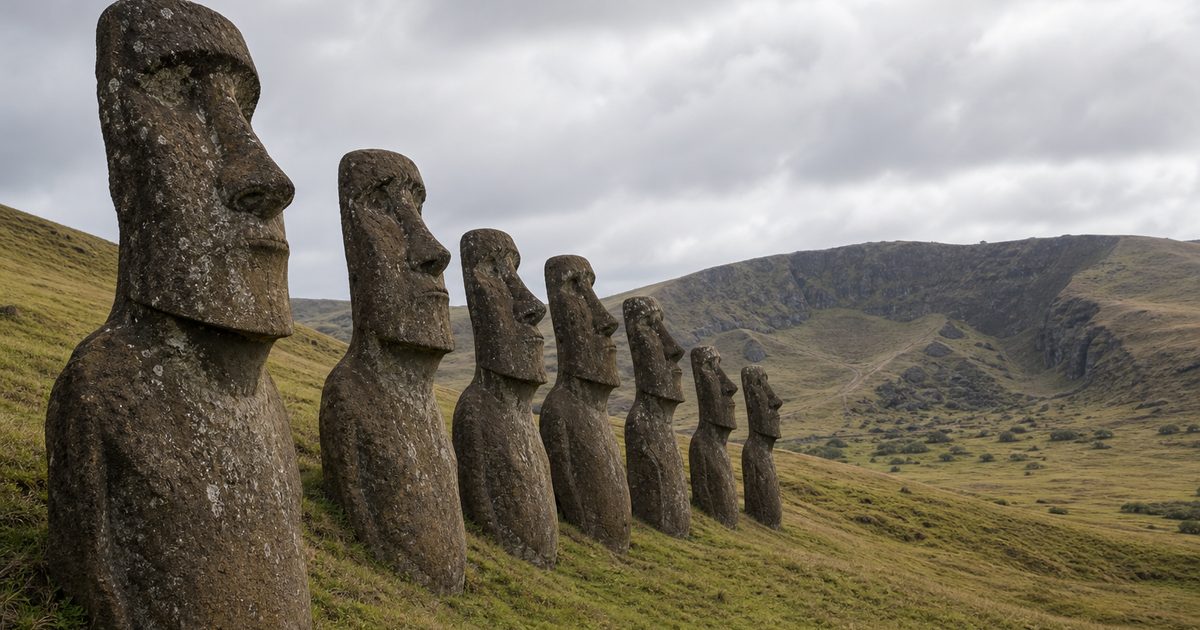
Nearly every road on Rapa Nui seems to bend back toward a face. Some stand upright on coastal platforms. Some lie broken where they were pulled down. On the slopes of Rano Raraku, others are still attached to the bedrock, their shoulders and long noses emerging from the volcanic stone as if the quarry paused mid-task and never resumed.
That unfinished scene is the best way into the Moai of Rapa Nui, often called the Moai of Easter Island. The statues are so familiar in photographs that they can seem detached from the island that made them. In fact, they only become legible when returned to their setting: a Polynesian society built around lineage and land, a quarry of soft volcanic tuff, and a ring of ceremonial platforms around the coast where ancestors were made present in stone.
Ancestors facing inland
Rapa Nui lies in the southeastern Pacific, at the eastern edge of the Polynesian Triangle. It is small, about 163.6 square kilometers, and far from continental South America. That isolation has encouraged a long habit of treating the island as a mystery. The statues suggest something more precise: a local system of belief, labor, and political authority worked out over generations.
Polynesian settlement is still debated in detail. Older estimates placed first arrival anywhere between 300 and 1200 CE. More recent radiocarbon work tends to support a later settlement, around 1200 CE. The settlers were Polynesians, often linked in scholarship to the Marquesas, though exact routes remain part of a wider discussion about migration across the Pacific.
The carving tradition belongs to the society their descendants built on the island. Dates vary in the literature, but the broad span usually given for Moai production runs from around 1000 CE into the second half of the 17th century, with the most intensive carving often placed between about 1250 and 1500.
These figures were not generic idols. They are widely understood to represent deified ancestors, chiefs, or other high-ranking people, described in Rapa Nui tradition as aringa ora ata tepuna, the living faces of the ancestors. Through them, ancestral mana, or spiritual force, remained active among the living.
That belief explains one of the most important facts about the statues: most face inland. They were usually raised on stone platforms called ahu, many of them built near the coast and often associated with burial sites. Rather than looking out to sea, the figures turned their attention toward clan lands and settlements. They watched over home ground.
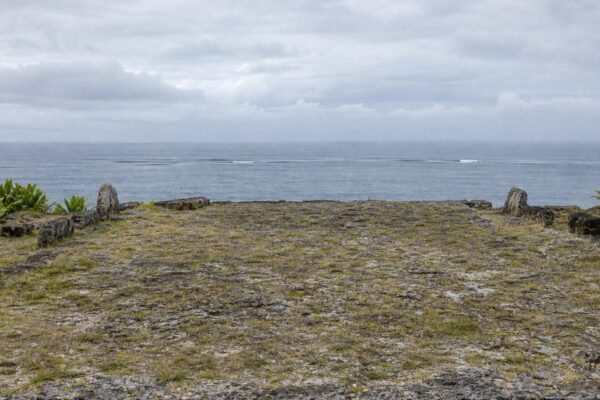
Ahu were not simple bases. They were ceremonial architecture, tied to lineage, death, and place. Research has also suggested that a significant share of these platforms show astronomical orientation. That does not turn the whole island into a code to be cracked, but it does show that placement was deliberate. Stone, ancestry, and landscape were arranged together.
Why “Easter Island heads” gets it wrong
The phrase “Easter Island heads” has done lasting damage to how the statues are understood. Many of the best-known examples appear to be little more than heads rising from the soil. In reality, Moai are full-bodied figures. Their torsos are often buried by sediment, not absent by design.
At Rano Raraku, where unfinished examples remain exposed in different stages, that is impossible to miss. The body was part of the concept from the start. The statues have broad torsos, arms carved close against the sides, and hands resting low on the abdomen. They do not have legs. Their heads are large, roughly three-eighths of the total height, which gives them their severe proportions and makes the face dominate the figure.
Scale matters here. An average Moai stands about 4 meters high and weighs around 12.5 tonnes. The largest one ever erected, known as Paro, stood close to 10 meters and weighed about 82 tonnes. At the quarry lies the largest unfinished example, often called El Gigante. Had it been completed, it would have reached about 21.6 meters.
Some statues also carried pukao, the red stone cylinders placed on top of the head. These were made from red scoria, not the tuff used for most figures. In photographs, the gray bodies often overshadow this detail, but on the island the contrast in material and color would have been striking.
Rano Raraku, where the figures began
If one place explains the Moai, it is Rano Raraku. This volcanic crater served as the main quarry, and about 95 percent of the statues were carved from its compressed volcanic ash, or tuff. The material is relatively soft compared with harder stone, which made it workable with toki, the stone tools available to Rapa Nui carvers.
A small number of statues, often given as around 14, were made from basalt. The overwhelming preference for tuff was practical. It could be shaped at scale without metal tools. That fact still deserves emphasis. The achievement was not a single feat but a sustained sculptural tradition that produced hundreds of monuments.
Calling Rano Raraku the “Moai factory” is common, but the phrase flattens the place. The quarry is less an industrial site than a record of process. Detached figures lie near partially carved ones. Others remain attached to the bedrock, their outlines still visible in the slope. Some stand upright because later sediment accumulated around them. Others lie horizontal, abandoned before release. The hillside preserves stages of work that elsewhere on the island have vanished.
It also preserves evidence against the lazy shorthand of “stone heads.” Here the bodies are obvious. So is the consistency of the sculptural language: long ears, heavy brows, prominent noses, compressed mouths, elongated torsos. The carvers were not improvising from statue to statue. They were working within a clear formal tradition.
How the Moai moved
Once carved, many statues had to travel from Rano Raraku to ahu around the island. That journey remains one of the most discussed parts of the story, and one of the least settled. Scholars agree that hundreds of massive figures were transported across Rapa Nui. They do not agree on every detail of how.
Local tradition says the statues “walked.” Told as tradition rather than engineering proof, the image has force. The forward lean of many Moai makes the idea feel oddly plausible even before any experiment enters the discussion.
Modern researchers have proposed several transport methods, including movement on sledges, rollers, or with ropes that allowed the statues to be rocked upright from side to side. None of that changes the central fact established by the island itself: a small Polynesian society quarried, carved, moved, and raised stone figures that commonly weighed more than 12 tonnes, and in some cases far more.
Transport was only part of the task. The destination mattered just as much. A Moai reached its full meaning when it stood on an ahu, often above ancestral remains, in relation to a particular lineage and place. Quarrying, movement, and erection were all parts of one ritual and political act.
Toppling, rupture, and the danger of simple collapse stories
The fallen statues are not ruins in the neutral sense. By the late 18th and early 19th centuries, the standing Moai had been toppled. This was not simply weathering. Islanders deliberately pulled many of them down.
Why that happened is still debated. Explanations have included conflict between groups on the island and changes accelerated by European contact. The text of the landscape gives the result more clearly than the motive: a long-standing ceremonial order broke apart.
That later history needs care. Rapa Nui has often been turned into a morality tale about “ecological collapse,” with the statues treated as evidence for a society that destroyed itself. The record is more complicated, and the 19th century matters enormously. Outside contact brought catastrophic violence and disease. Peruvian slave raids and epidemic disease devastated the population. By 1877, only 111 Rapa Nui people remained.
That number should change how the statues are discussed. Any account that lingers on how the figures were moved while skimming over enslavement, depopulation, and colonial control misses the human history that followed the carving tradition. The Moai are not proof of a fable about failure. They belong to a society that also endured profound external trauma.
Some statues that remained standing into the 19th century were later brought down as Christianity spread in the 1860s. The old sacred order was not merely forgotten. In many places, it was physically dismantled.
A ceremonial landscape, not a scatter of monuments
Seen one by one, the statues can look like isolated masterpieces. Seen across the island, they form a system. The Moai and ahu turned Rapa Nui into a ceremonial map of clan territories, burial places, and inherited authority.
That is why the quarry cannot be separated from the coast. A figure at Rano Raraku is only part of the story. A figure on an ahu has entered a relationship with land, ancestry, and community. Most face inland because their role was not to greet voyagers or guard the sea. Their presence was directed toward the living descendants of the dead they embodied.
Local tradition adds another layer to this sacred geography. Te Pito Kura, associated in tradition with a sacred stone brought by the founding king Hotu Matu’a from Hiva, belongs to that world of charged materials and ancestral force. Whether treated as tradition or legend, such stories show that spiritual power on Rapa Nui was not confined to statues alone. It could reside in stone, place, and origin.
What the Moai still ask of visitors
Much of this heritage lies within Rapa Nui National Park, a UNESCO World Heritage Site. The rules around access matter because the statues are not scenery and not props. They are protected archaeological and cultural sites, and many remain vulnerable to erosion, weather, and pressure from tourism.
At major sites, access is controlled. Visitors need a park ticket, and entry to places such as Rano Raraku and Orongo is restricted. Climbing on ahu or Moai is forbidden, as is removing stones or archaeological material. Those restrictions are not bureaucratic decoration. They reflect the fact that the island’s most famous monuments are also fragile and still meaningful to the Rapa Nui community.
Coastal erosion and rising sea levels threaten several sites. The modern history of protection is part of the Moai story now, just as surely as quarrying and toppling are. So is the effort to manage visitor numbers on an inhabited island with finite space and a past too often consumed as spectacle.
The old postcard image of Easter Island statues as mute heads in an empty landscape misses almost everything important. These are ancestral bodies carved from volcanic tuff, raised on burial platforms, oriented toward land and kin, and later cast down in a period of upheaval. On Rapa Nui, the stone faces are only the beginning. The real subject is the society that made them, lived with them, and still claims them.
FAQ
What are the Moai of Rapa Nui?
They are monolithic stone figures carved by the Rapa Nui people, generally understood to represent deified ancestors, chiefs, or other high-ranking individuals.
Why do most Moai face inland?
Most were raised on ahu near the coast and turned toward clan lands and settlements, where they expressed ancestral presence and mana.
Are the Easter Island statues only heads?
No. They are full-bodied figures. Many appear to be heads because sediment has buried their torsos.
Where were most Moai carved?
Most were carved at Rano Raraku from volcanic tuff. The quarry still contains unfinished and partly attached figures.
How many Moai are on Easter Island?
The documented total is usually given as somewhere between about 887 and 1000 statues.