Six and a half square kilometers of coral, no deep-water harbor, barely six meters above the sea: by any ordinary measure, Wake Island should have remained a footnote. Instead it became one of the first names Americans learned in the Pacific War, and it has never quite slipped back into anonymity.
That story begins with geography. Wake lies in the central Pacific, roughly 3,700 kilometers west of Honolulu and 2,400 kilometers northwest of Guam, just west of the International Date Line. It is not a single island but an atoll of three islets, Wake, Wilkes, and Peale, wrapped around a shallow lagoon. For ships, that setting was awkward. For aircraft, it was another matter. Long before the Battle of Wake Island made headlines, the atoll had already acquired the one quality that can turn a remote place into a strategic one: position.
A coral atoll in the right place
Wake’s recorded history in European navigation begins in 1568, when the Spanish expedition of Álvaro de Mendaña sighted it and named it San Francisco. In 1796, the British captain Samuel Wake saw the atoll, and his name endured. The U.S. Exploring Expedition charted it in 1841 under Charles Wilkes; Titian Peale, the expedition’s naturalist, gave his name to Peale Islet.
For centuries, though, the atoll mattered less for what it contained than for where it sat. It had no indigenous population. That absence should not be mistaken for emptiness in a cultural sense. Marshallese tradition knows the atoll as Enen-kio, and the Marshall Islands continue to claim it. Any account of Wake has to hold those facts together: no settled population on the atoll itself, but a wider Pacific world in which it was known, named, and valued.
The United States annexed Wake on January 17, 1899. Even then, annexation did not instantly make it important. The atoll had almost no fresh water, little arable land, and no harbor fit for major shipping. Its value emerged when long-distance flight began to redraw the Pacific.
In 1935, Pan American Airways turned Wake into a stop on its trans-Pacific China Clipper route. The company built facilities on Peale, including a hotel for passengers in transit. That episode is easy to romanticize, but its real significance was practical. Aviation proved that a place with few local resources could still become indispensable if it broke a vast ocean crossing into manageable stages. Wake Island’s strategic importance was already visible before the shooting started.
Why military planners kept returning to Wake
By the late 1930s, American planners were looking at the same map Pan Am had studied, only with different questions in mind. The Hepburn Board, reporting in 1938 on naval shore bases, recommended development at Wake as part of a broader Pacific defense system. The logic was blunt. Distance in the Pacific is not background; it is one of the main facts of war. Aircraft range, reconnaissance arcs, refueling points, and response times all depend on where a runway can be built.
Wake had obvious limits. The lagoon was shallow. Large naval vessels could not use it as a proper harbor. Surface operations would always be constrained. Yet that weakness sharpened its usefulness for an age increasingly shaped by air power. A coral atoll that could host aircraft, fuel, communications, and defenses was no longer marginal.
Construction of a military base began in January 1941. On February 14 of that year, Franklin D. Roosevelt issued Executive Order 8682, creating the Wake Island Naval Defensive Sea Area and the Wake Island Naval Airspace Reservation. The language was administrative. The meaning was not. The United States was hardening a point in the central Pacific before open war had begun.
By August 19, 1941, the first permanent garrison had arrived: 449 officers and men from the 1st Marine Defense Battalion, along with 68 Navy personnel and roughly 1,221 civilian workers. On a low atoll with no permanent civilian community, that was a striking concentration of labor, matériel, and intent. Wake was being turned into a military air outpost because the map left few alternatives.
December 1941: a tiny outpost becomes a symbol
The war reached Wake on December 8, 1941, local time, hours after the attack on Pearl Harbor across the Date Line. Japanese bombers struck the atoll, hitting an isolated base that could not easily be reinforced and could not easily be evacuated. In peacetime, remoteness had made Wake useful. In war, the same remoteness became a trap.
Then came the action that fixed the atoll in public memory. On December 11, a Japanese naval force attempted to land troops. The defenders, badly outnumbered and cut off, beat back the assault. They sank two Japanese destroyers and damaged other vessels. In American wartime memory, that moment became famous as the first tactical U.S. success of the Pacific War.
The phrase matters, but so does the scale. This was not a turning point in the grand strategic sense. It did not alter the balance of power in the Pacific. What it did was puncture the sense of uninterrupted Japanese momentum in the first bleak days after Pearl Harbor. For a brief moment, Wake Island showed that a small, prepared garrison on a coral base could inflict serious damage on an attacker.
That success also invited mythmaking. It is tempting to tell the story as one of pure defiance, a tiny atoll standing alone against an empire. The reality is harsher and more instructive. Wake’s defense succeeded briefly because the garrison was armed, alert, and skillful. It failed in the end because no isolated outpost can survive indefinitely without relief against a stronger force that returns with carriers, aircraft, and more troops.
On December 23, Japanese forces came back with reinforcements. After fifteen days of fighting, the defenders surrendered. Those two dates, December 11 and December 23, belong together. One marks a real tactical victory. The other marks the hard limit of defending a remote Pacific outpost without sustained support. To understand Wake Island history, you have to resist choosing only the heroic half.
Occupation and the violence that followed
After the surrender, most captured American military personnel and civilian contractors were sent to prisoner-of-war camps elsewhere in Asia. Wake then passed into Japanese control. It did not become quiet. American forces bombed the atoll repeatedly during the war, because even a small position could not simply be ignored once it sat inside the wider geometry of Pacific operations.
The most terrible event in Wake’s wartime history came later, on October 5, 1943, on Wilkes Islet. Japanese forces executed 98 American civilian prisoners. One of the prisoners briefly escaped and carved the words “98 US PW 5-10-43” into a coral rock before he was recaptured and killed. The site is now known as 98 Rock.
This is the point where any easy story of martial glory breaks down. Wake was not only a battlefield. It was also a place of captivity, forced labor, and atrocity. The 98 Rock memorial matters because it anchors the island’s history in something more than military legend. It marks the vulnerability of civilians caught inside imperial war and the way strategic geography can expose ordinary people to extraordinary violence.
Japanese control ended only after the broader war had already been decided. On September 4, 1945, the Japanese garrison on Wake formally surrendered to a detachment of United States Marines. By then the atoll’s fame was secure, but fame can flatten a place. The battle is remembered; the occupation and the killings deserve equal attention.
Why Wake still matters
After 1945, Wake did not revert to being merely a remote atoll in Micronesia. Its role changed, but the underlying logic remained. In 1962, responsibility for the atoll was placed under the Department of the Interior, while administration in practice continued through the military. That arrangement captures something essential about the place. Wake is a U.S. territory with no permanent residents, managed less as a civic space than as a controlled strategic site.
Its later uses followed the same pattern. During the Cold War, and especially from the 1970s onward, the atoll became important for missile-related testing and military operations. Administration was funded from October 1, 1994, by the Ballistic Missile Defense Organization. The terminology shifted over time, but the reason did not. A secure airfield in the central Pacific still offered value because distance, access, and isolation remain military assets.
Wake also served, briefly, in a very different register. In 1975, during Operation New Life, Vietnamese refugees passed through the atoll for processing. Even that humanitarian episode depended on the same basic fact that had drawn Pan Am and the Navy: infrastructure in the right place.
More recent investment has again focused on airfield and support facilities. The language now is about readiness, logistics, and competition in the Pacific. That can sound contemporary, but the deeper pattern is old. Wake matters whenever states need a controlled point between larger centers of power. The atoll has almost never been important for what it can produce on its own. It has mattered for what can be projected through it.
The landscape as evidence
Wake Island today has no permanent population. At any given time, the people there are usually military personnel and civilian contractors, often numbering around 100 to 300. Access is tightly restricted. There is no ordinary tourist flow, and that restriction is part of the story rather than an inconvenience to write around. This is not a destination in the usual sense. It is an active military site layered over a historic battlefield and, in environmental terms, part of the Pacific Remote Islands Marine National Monument.
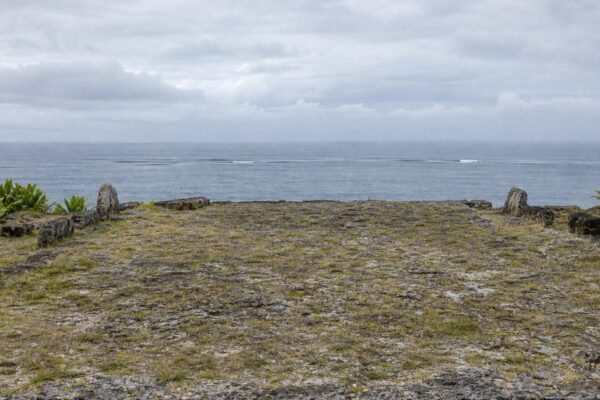
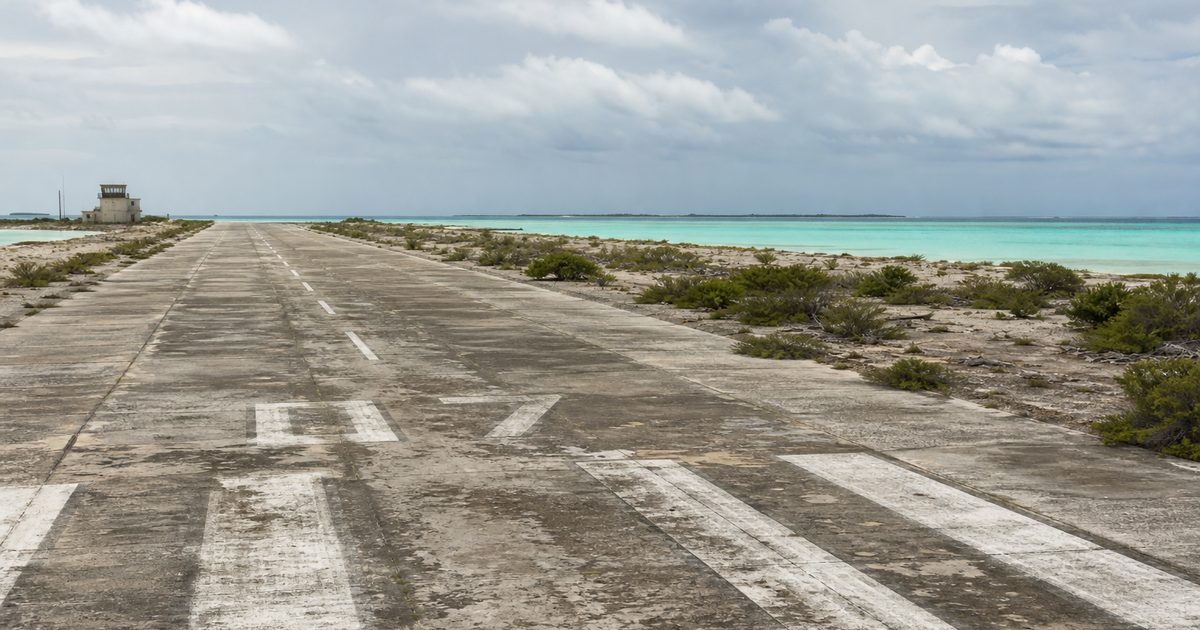
The physical landscape still shows the long continuity of strategic use. Roads and bridges link the three islets. A runway of about 9,800 feet cuts across the atoll, the clearest single expression of why Wake has mattered for so long. Remains of Japanese fortifications survive on Wake, Wilkes, and Peale. On Wilkes, 98 Rock remains the most charged site of all: not picturesque, not grand, but exact.
That combination of features explains more than any abstract label can. Wake is a coral atoll, a wartime landmark, a memorial landscape, a restricted military installation, and a protected marine area. Those roles can seem uneasy beside one another. In fact they reveal the same continuity. Again and again, larger powers have looked at this small ring of coral and seen not what it is in itself, but what its location allows.
That was true when Pan American flying boats paused there on ocean crossings. It was true during the Battle of Wake Island in December 1941. It remains true now. The map has not changed, and Wake’s strategic importance has always begun with the map.
FAQ
Why is Wake Island famous?
Wake Island is best known for the Battle of Wake Island in December 1941, when U.S. defenders repelled an initial Japanese landing before the atoll fell later that month.
Is Wake Island inhabited?
There are no permanent residents. The atoll is occupied temporarily by U.S. military personnel and civilian contractors.
Who controls Wake Island?
Wake is an unorganized, unincorporated territory of the United States. The Marshall Islands also maintain a claim based on Marshallese tradition and history.
Can civilians visit Wake Island?
Access is heavily restricted and generally limited to people with official authorization, usually through U.S. military channels or related agencies.
What is 98 Rock on Wake Island?
98 Rock is the memorial site on Wilkes marking the mass grave of 98 American civilian prisoners executed by Japanese forces on October 5, 1943.