
A clay tablet could hold what memory could not: quantities of grain, allocations of goods, the details of a transaction. At Uruk, near the end of the fourth millennium BCE, such records became part of the machinery of city life.
The surviving tablets are small. The settlement that produced them was immense by the standards of its time. Tens of thousands of people lived around monumental religious precincts, supported by an agricultural landscape threaded with waterways. Eventually, a wall roughly nine kilometers long enclosed the city.
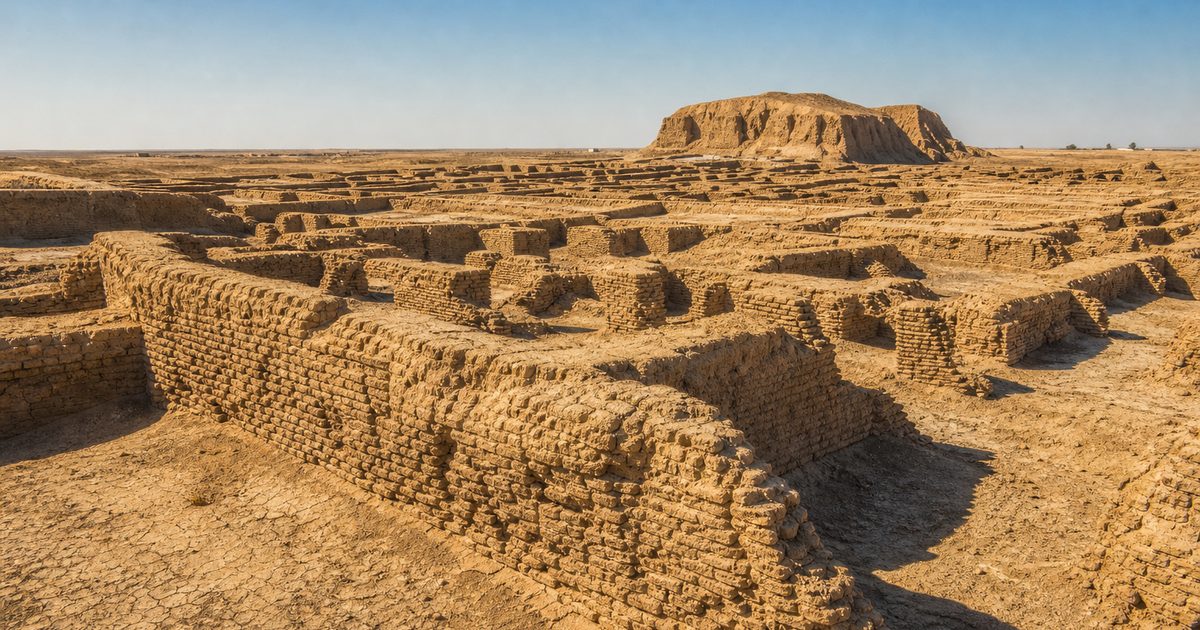
Today, the ruins lie at Warka in southern Iraq, beside a former channel of the Euphrates. Their significance rests in the relationship between those modest clay records and the enormous buildings around them. Here, archaeologists can trace how a settlement acquired the institutions, specialized work and systems of information that made urban life possible.
What makes a settlement a city?
Size alone does not settle the question. A large agricultural village might contain many inhabitants without supporting the concentration of institutions and specialized activities associated with a city.
Uruk presents a different picture. Its monumental precincts required sustained construction work. Its administrative records reveal institutions handling goods and labor. Its growth brought people together on a scale that demanded arrangements beyond those of a small farming community.
By the closing centuries of the fourth millennium BCE, it had become one of the largest settlements known anywhere. Estimates for its population around the transition to the third millennium commonly range between 40,000 and 80,000. Reconstructions of its extent reach several hundred hectares.
Neither figure comes from a census. Archaeologists infer population from the occupied area and assumptions about settlement density; different reconstructions produce different totals. Nor should every estimate of the city’s size be treated as a measurement of the same moment.
The scale nevertheless matters. Feeding that population, organizing work and managing supplies required durable institutions. Calling Uruk a “first city” recognizes how clearly these developments appear together here. It does not establish that every component of urban life originated within its boundaries.
A city assembled over centuries
Long before its monumental buildings rose, people occupied the site during the fifth millennium BCE, in the Ubaid period. The metropolis emerged through a lengthy sequence of occupation, rebuilding and expansion.
Two precincts became especially important: Eanna, associated with the goddess Inanna, and the Anu district, traditionally linked with Kullaba. These centers help explain the city’s shape, although their earliest histories are less straightforward than a story of two villages neatly merging.
Excavation reveals successive buildings and changing layouts rather than a single founding event. Later construction covered or cut into earlier remains. Even where archaeologists can follow the sequence, assigning exact dates and functions remains difficult.
Ancient tradition supplied a more personal origin. The Sumerian King List credits Enmerkar with building Uruk. Such accounts organized the past around rulers and their achievements; they are not contemporary records of the settlement’s beginnings.
The distinction changes how the ruins read. Instead of looking for the moment one king created a city, the archaeological question concerns accumulation: how repeated decisions about buildings, resources and authority produced something larger than any earlier settlement.
Monumental precincts and organized labor
The Uruk period, conventionally dated to approximately 4000-3100 BCE, takes its name from the site. Its later centuries saw a major expansion in monumental construction.
At Eanna, builders created large halls, courtyards and elaborately decorated structures. Some surfaces carried patterns made with colored clay cones pressed into plaster. Their scale and finish distinguish these buildings from ordinary domestic architecture.
Calling every monumental structure a temple, however, can imply more certainty than the evidence allows. Religious activity, administration and the storage or distribution of goods could overlap within major institutional precincts. Archaeologists continue to debate the functions of individual buildings.
The White Temple offers a more recognizable religious form. Built around the end of the fourth millennium BCE, it stood on a high terrace in the Anu district. Its pale exterior gave the building its modern name.
The elevated structure would have dominated the surrounding settlement. Reaching it meant ascending above the level of ordinary streets and houses, a physical separation that expressed the importance of the activities conducted there.
Construction itself tells another part of the story. Producing bricks, transporting materials and repeatedly enlarging platforms demanded coordinated labor. These buildings are evidence of an institution’s ability to mobilize resources, even when the precise arrangements behind that authority remain uncertain.
What survives most visibly is therefore an uneven record. Monumental precincts reveal a great deal about institutional ambition, but less about the homes and daily negotiations of the people whose work sustained it.
When accounting became writing
Around 3300-3200 BCE, the archaeological record at Uruk contains some of the earliest widely recognized evidence of writing. These tablets use the system scholars call proto-cuneiform.
Much of their content concerns administration: quantities, commodities, allocations and categories of people or goods. Numerical signs appear alongside signs representing objects and concepts. Some tablets contain lists that organized knowledge rather than recording a particular transaction.
The tablets did not yet reproduce spoken language in the way later cuneiform could. Reading them often means reconstructing an accounting procedure rather than translating a sentence.
That limitation is revealing. The earliest surviving writing addressed particular institutional needs. It made information durable, separable from the person who first knew it, and available for later checking.
Seals formed part of the same administrative environment. A cylinder seal could roll an image across wet clay, leaving a repeating impression. Such impressions helped identify or authorize transactions and secure containers or closures.
Writing did not simply grow out of seals in one direct sequence. Numerical recording, sealing practices and other ways of managing information contributed to a more complex history.
Many early tablets also survive outside their original working context, in deposits containing discarded material. They preserve traces of administrative activity without giving archaeologists an intact office or a complete archive.
Uruk remains central to the history of writing because of the scale and importance of this evidence. The broader question of how writing emerged requires comparison with developments elsewhere in Mesopotamia and neighboring regions.
Growth without a clearly mapped empire
During the later fourth millennium BCE, material associated with southern Mesopotamia appears across a much wider area. Scholars often discuss this spread under the label “Uruk expansion” or “Uruk phenomenon.”
The evidence includes architectural forms, pottery and administrative practices. At some sites, the connections suggest communities with strong southern ties. Elsewhere, local societies adopted selected objects or techniques.
Those differences matter. Similar pottery does not by itself prove political control, and an administrative practice can travel without an army.
The expansion raises questions about exchange, migration and the search for resources unavailable in the southern alluvial plain. It also reveals the limits of reconstructing power from objects. Archaeologists cannot turn the distribution of related material into a reliable map of an empire ruled from this city.
For the urban story, the important point is that the settlement did not develop in isolation. Its institutions belonged to networks extending beyond the surrounding fields. The city concentrated people and resources while depending on relationships outside it.
The wall and the king who inherited its memory
The roughly nine-kilometer circuit of Uruk’s wall gave the settlement a powerful external form. Its surviving traces belong to a construction history generally associated with the early third millennium BCE, although dating the defenses precisely is difficult.
A wall could protect a population, regulate movement and mark a distinction between city and countryside. Its length also makes the scale of the enclosed settlement easier to grasp than an estimate expressed in hectares.
Later tradition credited Gilgamesh with the defenses. He appears as a king of Uruk in Mesopotamian literature and the Sumerian King List, but those sources do not establish that he built the surviving circuit.
The literary connection is nevertheless important. In the Epic of Gilgamesh, the city’s brickwork provides a material counterpoint to the king’s confrontation with mortality. The buildings endure beyond an individual life.
The epic developed through several stages, drawing on earlier Sumerian stories before taking shape in Akkadian versions. It belongs among the world’s oldest surviving literary traditions, rather than being securely identifiable as its single oldest literary work.
There is a long interval between the first administrative tablets and these compositions. They should not be collapsed into one achievement. The city that helped make quantities recordable later became a setting through which writers explored kingship, loss and the limits of human power.
Reading the remains at Warka
The end of the fourth millennium did not end the city’s history. Uruk remained occupied through many subsequent political and religious changes, and its buildings accumulated over millennia.
That long occupation complicates the view across the ruins. Not every visible structure belongs to the first urban expansion. Later sanctuaries, rebuilding and excavations interrupt the earlier landscape.
German-led excavations began in 1912 and continued intermittently, with conflict repeatedly affecting archaeological work. The site now belongs to the UNESCO World Heritage property The Ahwar of Southern Iraq: Refuge of Biodiversity and the Relict Landscape of the Mesopotamian Cities.
At the Anu precinct, the elevated remains help convey the effort invested in separating sacred architecture from the surrounding ground. Elsewhere, excavated walls and plans require closer interpretation. A low line of brick may represent only one phase of a building repeatedly replaced.
The dry former river channel supplies another necessary clue. The modern landscape does not reproduce the waterways that helped sustain the ancient population. Reading the early city means recovering those connections as carefully as its buildings.
FAQ
Where is Uruk located today?
The archaeological site, also called Warka, lies in Iraq’s Muthanna Governorate, east of the present Euphrates, beside a former river channel.
Was Uruk the first city in the world?
It is widely described as one of the earliest true cities. Its claim rests on its scale, monumental institutions and administrative complexity, although “first” depends on how scholars define a city.
How many people lived in Uruk?
Estimates around its early urban height commonly range from 40,000 to 80,000. These are archaeological reconstructions, not recorded population counts.
Was writing invented at Uruk?
Some of the earliest widely accepted evidence of writing comes from the site, around 3300-3200 BCE. The surviving proto-cuneiform tablets largely concern administration.
Did Gilgamesh build Uruk’s walls?
Mesopotamian literary tradition credits him with the walls. Archaeology does not securely connect the surviving defenses to a historical ruler named Gilgamesh.