At high tide, the line between land and water blurs fast on the Georgia coast. Marsh grass disappears at the edges, mud banks soften, and a beach that looked broad in the morning can seem briefly pinched by afternoon. Sea Island sits inside that restless system. Its gates and clipped lawns suggest permanence. The ground beneath them tells a different story.
Sea Island, Georgia, is small, roughly 8 kilometers long and 2.4 kilometers across at its widest point, set east of St. Simons Island in Glynn County within the Golden Isles. Yet its scale is misleading. The island belongs to a much larger coastal world of dunes, tidal creeks, salt marsh, oyster reef, maritime forest, and turtle beach. What makes it interesting is not simply that it became exclusive. It is that one of the South’s most carefully staged resort landscapes was laid over a barrier island that never stops shifting.
A coast built by tide and sediment
Sea Island formed within the chain of barrier islands that arcs along South Carolina, Georgia, and northern Florida. On the Georgia coast, those islands have a distinct structure. They are composite barriers: older Pleistocene cores with younger Holocene deposits wrapped around them. In simpler terms, they have an older spine and younger edges that move.
That mobility matters because this is not a coast shaped only by surf. Wave energy here is lower than on many other Atlantic shorelines, while tides commonly rise and fall by about 2 to 3 meters. Fine sediment arrives from rivers draining the Piedmont. The result is a landscape where sand, mud, tidal water, and marsh are constantly rearranged.
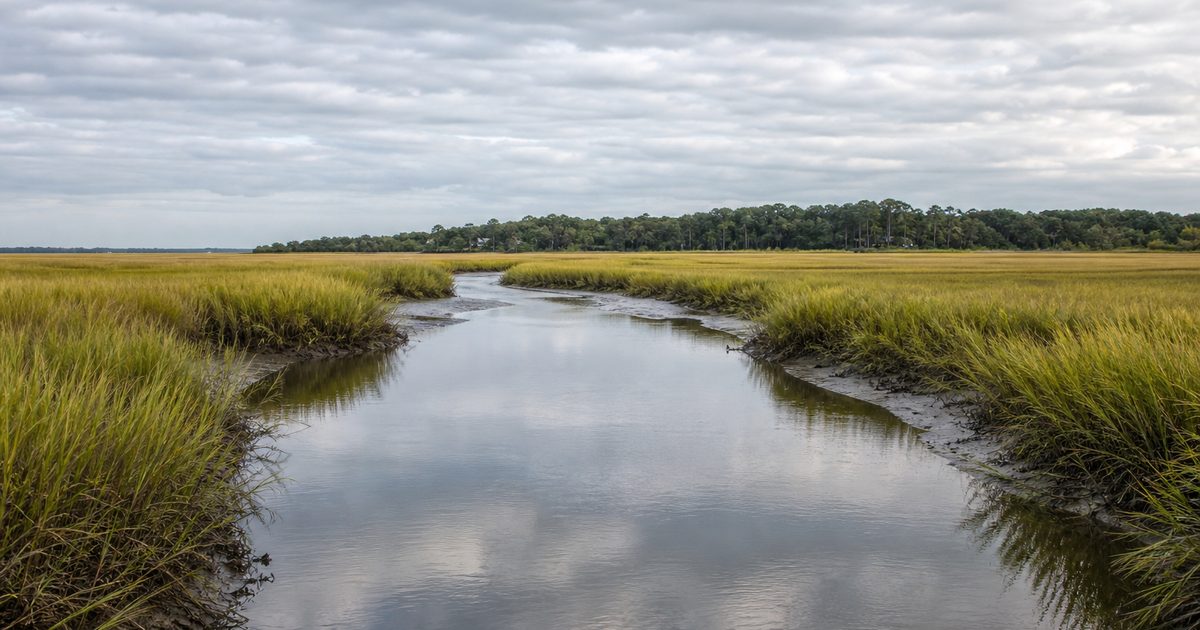
So Sea Island cannot be read from its oceanfront alone. The beach is only one face of it. The island also belongs to the estuarine side of coastal Georgia, where broad marshes and tidal flats do much of the real work. Across the Georgia coast, saltmarsh covers about 149,000 hectares. Those marshes are not empty space between solid land and open sea. They are the mechanism that ties the whole coast together.
This is why the polished image of the island can be misleading. The setting that later came to signify privacy and wealth began as a low, active landform shaped by quiet forces: tide, sediment supply, and slight changes in elevation that matter more than they first appear.
Forest, marsh, dune
The basic sequence of a barrier island still shows clearly here. Dunes front the Atlantic. Behind them sit the uplands and maritime forest. Beyond and around them lie marshes, creeks, and tidal waters, including the Black Banks River.
The maritime forest gives Sea Island much of its settled look. Live oak, Quercus virginiana, is the signature species, joined by eastern redcedar, Juniperus virginiana, slash pine, Pinus elliottii, and cabbage palmetto, Sabal palmetto. These trees tolerate salt, wind, and sandy soils. They also supplied the visual language that later developers leaned on so heavily. The resort did not invent the island’s sense of age. It borrowed it from the forest, especially from the broad, low architecture of the live oaks.
The marsh works by different rules. In low marsh, smooth cordgrass, Spartina alterniflora, dominates. Elsewhere grow needlerush, Juncus roemarianus, saltgrass, Distichlis spicata, and glasswort, Salicornia species. From a distance the marsh can look uniform, almost flat in every sense. Up close, it resolves into zones controlled by flooding, salinity, and tiny shifts in height. A few centimeters can change what grows where.
Wildlife moves through each part of this system. Deer and alligators are part of the island’s fauna. The wider Georgia coast is important for shorebirds, including the threatened piping plover and the red knot. Florida manatees appear in local waters as rare and vulnerable visitors. Along mud banks and tidal flats, eastern oyster reefs shelter juvenile fish, shrimp, and blue crabs.
Then there is the beach itself. For resort marketing, the shore reads as frontage and view. Ecologically, it is nesting habitat for loggerhead sea turtles, the most common sea turtle in Georgia waters. That distinction matters. The same strip of sand has to function as habitat, protective edge, and managed amenity, and those roles do not always sit comfortably together.
Before exclusivity
Long before the resort era, coastal Native Americans knew the island as Fifth Creek Island. In the early 19th century it was called Long Island and was used for grazing cattle by plantation owners from St. Simons Island.
That earlier use fits the nature of barrier islands. They were often working landscapes rather than places of dense settlement: useful for grazing, hunting, timber, and access to coastal waters, but difficult ground on which to build anything permanent at scale. Sea Island’s present identity can obscure that older practicality. Before architecture and membership rules, the island was valued for what open coastal land could provide.
The broader Georgia Sea Islands also carry the history of Gullah Geechee communities, shaped by the descendants of enslaved West Africans. That history belongs beside the resort story, not outside it. Coastal exclusivity did not arrive on empty land or in a landscape without memory. Development across the region has put pressure on those cultural landscapes, and any honest account of Sea Island has to keep that larger context in view.
Howard Coffin’s design on unstable ground
The decisive shift came in 1926, when automobile magnate Howard Coffin bought Sea Island and other nearby coastal lands. Coffin, a founder of the Hudson Motor Company, understood that the car was changing the geography of leisure. Places once considered remote could now be turned into destinations.
He was not simply buying shoreline. He was composing an experience. In October 1928, The Cloister Hotel opened as the centerpiece of the new resort, designed by Addison Mizner. Around it came the supporting elements of an elite coastal enclave: a beach club, fishing dock, tennis courts, and a shooting school near the hotel. Private cottages followed along a three-mile drive down the center of the island.
This was development, but not the kind that produces a conventional town. Coffin’s project worked more like estate planning on a barrier island. Roads, cottages, lawns, and club spaces were fitted into the existing ecological structure, especially the forested uplands and the beachfront edge. The marshes, dunes, and tidal waters were not erased. They were framed, controlled, and turned into scenery.
That choice helps explain why the place still looks the way it does. The resort did not fight the visual forms of the island. It appropriated them. Live oaks suggested age. Marsh views suggested distance. A narrow approach through a marsh-fringed landscape made arrival feel selective before any gate came into view.
Coffin also showed an interest in adaptive reuse, including the conversion of an old corn barn into a golf clubhouse. That detail matters because it complicates the usual story of luxury development as pure replacement. Sea Island’s built image was curated, but it was curated partly through older forms and local materials, arranged to make the island feel rooted even where the shoreline itself was not.
Why ecology became part of the brand
Exclusivity on Sea Island has always depended in part on ecology. Barrier islands are difficult places. They are separated from the mainland, edged by marsh, constrained by narrow uplands, and exposed to erosion. Those same qualities also make them useful for creating social distance.
Today the island is private and gated. Access to resort facilities, including The Cloister, The Lodge, the Beach Club, and the golf courses, is restricted to resort guests and Sea Island Club members. There is no public land access to the beach from the mainland. That controlled access has long been central to the island’s appeal. It also helps explain why Sea Island hosted the G8 Summit in June 2004, when seclusion and security were practical advantages, not just symbols of status.
Institutional prestige is easy enough to list. More revealing is the spatial logic. On many coasts, barrier-island scenery has been subdivided into repetitive lots and standardized views. Here, private control allowed a different result: maritime forest, drive, lawn, cottage, and beach were made to read as parts of a single estate landscape.
Even the commemorative live oaks planted by prominent guests fit that pattern. Presidents Calvin Coolidge, Gerald Ford, and Jimmy Carter are among those associated with such plantings, as is Queen Juliana of the Netherlands. The live oak is a real ecological presence on the island, but it also became a social symbol. On Sea Island, status was repeatedly tied to the local landscape rather than set apart from it.
The shore does not hold still
No amount of planning makes a barrier island stable. Sea Island’s polished image rests on a shoreline that continues to move, erode, and require intervention.
Beach erosion is a persistent concern, and coastal development can intensify it, especially where hard structures such as groins interrupt the natural movement of sediment. That creates one of the island’s central tensions. The beach must serve as habitat and protective edge while also functioning as the front yard of a luxury resort.
Sea Island Company has carried out beach renourishment for more than 30 years, creating dry sand beach and dune habitat. Renourishment can help preserve usable shoreline and support nesting and dune systems, but it also reveals the underlying fact: the ocean edge does not maintain itself in the form the resort prefers. It has to be managed.
The same tension appears on less developed stretches of coast. In 2015, environmental groups secured a conservation easement that preserved 90 percent of an 80-acre spit as undeveloped land. In absolute terms, 80 acres is not a vast figure. On a barrier island, though, a spit can be one of the most active and ecologically significant landforms in the system. It is exactly the sort of place where development pressure collides with coastal process.
Sea-level rise adds another layer of pressure, as do the needs of sea turtles and shorebirds whose habitat depends on how the shoreline is managed. The island projects stillness. Its ecology keeps disproving that impression.
What Sea Island reveals
Much of the original resort concept remains visible. The Cloister still anchors the island’s image, even after its rebuilding in the early 2000s retained the spirit of the earlier design. Private cottages and the residential landscape continue the pattern established in the first resort era. The Sea Island Golf Club, on nearby St. Simons Island at the site of the former Retreat Plantation, extends that world into a broader coastal landscape shaped by older land use and newer leisure.
Yet the most revealing features are not the ones polished for display. They are the forms that persist beneath and around the design: dunes along the ocean, maritime forest in the uplands, salt marsh opening toward tidal water, the Black Banks River, oyster habitat on mud banks and flats, and the visible signs of coastal management along the shore.
Sea Island is often presented as finished, controlled, and set apart. Its deeper story is less settled. This is a Georgia barrier island that began taking shape about 5,000 years ago and still behaves like one. Tides, sediment, habitat, architecture, and wealth have been layered together here for less than a century. The land beneath that arrangement remains provisional.
FAQ
Is Sea Island, Georgia, a private island?
Yes. Sea Island is private and gated, and access to resort facilities is limited to guests and Sea Island Club members.
How did Sea Island form?
It is part of Georgia’s barrier-island chain, formed about 5,000 years ago after the last major ice age. Like other Georgia barrier islands, it has older Pleistocene cores and younger Holocene deposits.
What habitats define Sea Island?
Its main habitats include ocean beach, dunes, maritime forest, salt marsh, tidal creeks, mud flats, and oyster reef.
What wildlife is associated with Sea Island?
The island and nearby waters support deer, alligators, shorebirds such as piping plovers and red knots, loggerhead sea turtles, eastern oysters, and occasional Florida manatees.
When did Sea Island become a resort?
Its modern resort history began in 1926 when Howard Coffin bought the island. The Cloister Hotel opened in October 1928.