At 53°04′30″S 73°30′00″E, the map is still provisional.
Far out in the Southern Indian Ocean, Heard and McDonald Islands rise from the Kerguelen Plateau, a vast volcanic platform whose history reaches back more than 115 million years. The territory is Australian, uninhabited, and heavily protected. Its fascination lies in a rare conjunction: Australia’s only active volcanoes stand inside one of the few island systems left with almost no direct human introductions of plants or animals. Fire is still making ground here. Ice is still stripping it back. Life keeps finding a foothold in between.
That is the real subject of Heard and McDonald Islands. Not remoteness for its own sake, and not a catalogue of wildlife, but a place where geology and ecology are visibly tied together. On Heard Island, glaciers descend the flanks of an active stratovolcano. On McDonald Island, eruptions in the late 20th century enlarged the island itself and erased its vegetation. Across the territory, fresh lava, retreating ice, black beaches and breeding colonies form one continuous story.
A volcanic platform breaking the surface
The setting is not incidental. Heard and McDonald Islands are the emergent edge of the Kerguelen Plateau, a submerged large igneous province in the Southern Ocean. The plateau is ancient on a geological timescale, but the islands are among its younger and more active expressions.
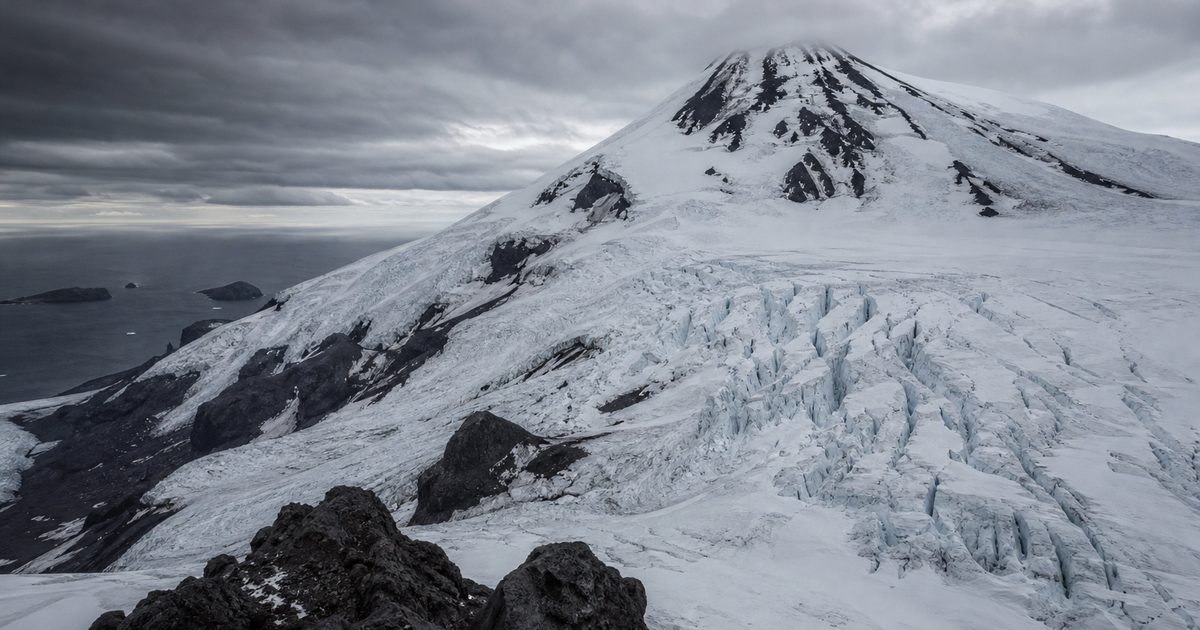
Heard Island covers 368 km². It is steep, glaciated and dominated by Big Ben, the volcanic massif that shapes almost everything else on the island. Its summit, Mawson Peak, is officially 2,745 metres high, which makes it Australia’s highest point outside the Australian Antarctic Territory. Even that number is not entirely settled. Because the volcano remains active, estimates of the peak’s present height vary.
The exposed lavas on Big Ben are mainly basanite, basalt and trachybasalt. Those rock names matter because they point to an active system rather than a worn-down relic. This is not a cone preserved as scenery. Heat, gas and new rock still enter the landscape.
Big Ben in the present tense
Many volcanic islands carry their drama in the past. Heard Island does not.
Big Ben has shown continuing activity, including regular steam and vapour emissions and occasional lava flows. A recorded lava eruption occurred in November 2020. So the Heard Island volcano belongs to the present tense, not just to deep time.
That activity matters beyond the summit. The Laurens Peninsula on Heard Island is also volcanic in origin and contains extensive lava tunnels, evidence of earlier flows that moved through the island in enclosed channels before cooling into hard shells. Elsewhere, volcanic construction meets glacial erosion, wind and surf. The result is a landscape that never quite settles.
There may be a wider consequence offshore. Volcanic processes on Heard Island are thought to release iron into surrounding waters, and in nutrient-limited parts of the Southern Ocean that can help support marine productivity. The link is still a scientific one rather than a scenic flourish: the chemistry of fresh volcanic material may influence life well beyond the shoreline.
McDonald Island, remade within years
If Heard Island shows persistence, McDonald Island shows speed.
The McDonald Islands group covers 2.45 km², and McDonald Island’s highest point is 230 metres. Its volcano appears to have been dormant for about 75,000 years before activity resumed in the 20th century. Significant eruptions were recorded in 1992 and 1997.
Those eruptions changed the island’s outline. During the 1990s, volcanic activity roughly doubled McDonald Island’s size and raised its height by nearly 100 metres. Few places offer such a clear example of an island being redrawn within a decade. New lava and ejecta did not just alter the surface. They expanded the island itself.
The ecological effect was immediate. The same eruptive phase destroyed the island’s vegetation. That was loss, plainly. It was also a reset. Bare volcanic substrate replaced established plant cover, and any later ecological succession had to begin again on fresh ground.
This is one reason the territory matters scientifically. Here, volcanism is not inferred only from old rock layers. It can remove habitat, create land and restart ecological processes within living memory.
Ice over fire
On Heard Island, about 70% of the surface is covered by glaciers year-round. That fact gives the island its starkest tension: an active volcanic edifice draped in ice.
The balance has shifted over time. Glaciated area fell from about 80% in the 1940s to around 64% in 2014. On a small island, that is a large physical change. Valleys, coastal margins and lower slopes have been exposed within a span that people can document directly.
These glaciers respond quickly to climatic shifts, which makes Heard Island unusually valuable for observing environmental change. Newly deglaciated ground allows researchers to study how plants and animals establish themselves on land only recently released by ice. In many places, ecologists reconstruct succession from fragments. Here, they can watch it unfold.
This is where the islands’ geology and biology become inseparable. Retreating glaciers uncover young surfaces. Eruptions create others. Ash, lava, sediment and meltwater produce a patchwork of raw ground at different stages of exposure. Life arrives on that patchwork unevenly, and the pattern matters. The wilderness of Heard and McDonald Islands is not a static condition. It is an active assembly.
An intact sub-Antarctic system, with a warning attached
The most unusual thing about these islands may be what has not happened to them.
Heard and McDonald Islands are often described as one of the world’s rare pristine island ecosystems. More precisely, they are the only sub-Antarctic island group with an intact ecosystem to which no known species have been introduced directly by humans. On many remote islands, ecological history is inseparable from rats, cats, grazing animals or invasive plants. Here, that familiar pattern has largely been absent.
The flora is sparse in the way cold volcanic islands often are, not lush in the way outsiders tend to imagine island life. Heard Island has 12 recorded species of vascular plants. Much of the diversity sits closer to the ground: 62 recorded bryophyte species and 71 recorded lichen species. These are communities adapted to exposure, limited soil and severe weather.
Yet even here, intact does not mean invulnerable. Poa annua, an invasive grass, is a concern in the expanding ice-free areas of Heard Island. That matters because newly exposed ground is exactly where ecological futures are being written. In a territory valued for its minimal human alteration, biosecurity is not an administrative footnote. It is central to the meaning of the place.
Breeding on young ground
The animal life of Heard Island is abundant, but its significance lies in where it breeds.
The island supports large breeding populations of eastern rockhopper, gentoo, macaroni and king penguins. It holds about 20% of the world’s macaroni penguins, with more than one million breeding pairs. That figure alone makes it one of the major seabird sites in the Southern Ocean.
Southern elephant seals and Antarctic fur seals also breed here in substantial numbers, alongside at least 15 breeding species of flying seabirds. Among the more local forms are the Heard Island cormorant, Leucocarbo nivalis, and the Heard Island sheathbill, Chionis minor nasicornis. The text of older classifications sometimes treats some of these birds differently, but within this territory the point is clear enough: several breeding seabirds are highly local to the islands.
What matters in this context is not simply species richness. It is the physical stage on which these colonies exist. Beaches, lowlands and coastal terraces have been shaped by lava, glacial advance and retreat, and relentless marine erosion. As ice withdraws, habitat shifts. As eruptions alter terrain, breeding space can disappear or emerge. On McDonald Island, volcanism removed vegetation entirely. On Heard Island, deglaciation exposes new ground for colonisation. The fauna is not set against a dramatic backdrop. It is living on terrain that is still being rewritten.
Protection, and the limits of access
The reserve’s strict protection follows directly from that fragility.
Heard and McDonald Islands are a strict nature reserve and a UNESCO World Heritage Site, managed by the Australian Antarctic Division. Unauthorised entry has been prohibited since May 2014. Visitors require permits, training and strict quarantine compliance, and access is mainly for science and monitoring.
That framework is not bureaucratic excess. A territory with no permanent population, almost no routine visitation and such unusual ecological intactness cannot absorb casual access without risk. The main concerns are clear enough: climate-driven glacial retreat, the spread of Poa annua, and the chance that unauthorised visits could breach biosecurity.
Human traces do exist, though they are limited. Heard Island still holds the remains of 19th-century sealing sites, as well as the Atlas Cove station site used by the Australian National Antarctic Research Expeditions from 1947 to 1955. Those traces matter because they keep the history honest. Even here, at the far edge of the Southern Ocean, people have extracted, occupied and left marks. The difference is scale. Human presence never became continuous enough to reorganise the ecosystem in the way it did on many other islands.
What remains, then, is a rare combination: active volcanoes on both Heard and McDonald Islands, glaciers still covering much of Heard Island, and immense colonies of penguins and seals occupying coasts made by fire and ice. In most places, wildness is imagined as something old and settled. Here it is younger, less stable and still under construction.
FAQ
Are Heard and McDonald Islands inhabited?
No. The territory has no permanent human population.
Where are Heard and McDonald Islands?
They lie in the Southern Indian Ocean, about 4,000 km southwest of mainland Australia and roughly 1,700 km north of Antarctica.
Are there active volcanoes on Heard and McDonald Islands?
Yes. The territory contains Australia’s only active volcanoes, including Big Ben on Heard Island and the volcanic system on McDonald Island.
What is Mawson Peak?
Mawson Peak is the summit of Big Ben on Heard Island. Its official height is 2,745 metres, though active volcanism means estimates can vary.
Why are Heard and McDonald Islands important for conservation?
They preserve an unusually intact sub-Antarctic ecosystem with no known species introduced directly by humans, making them important for studying ecological succession, biosecurity and environmental change.