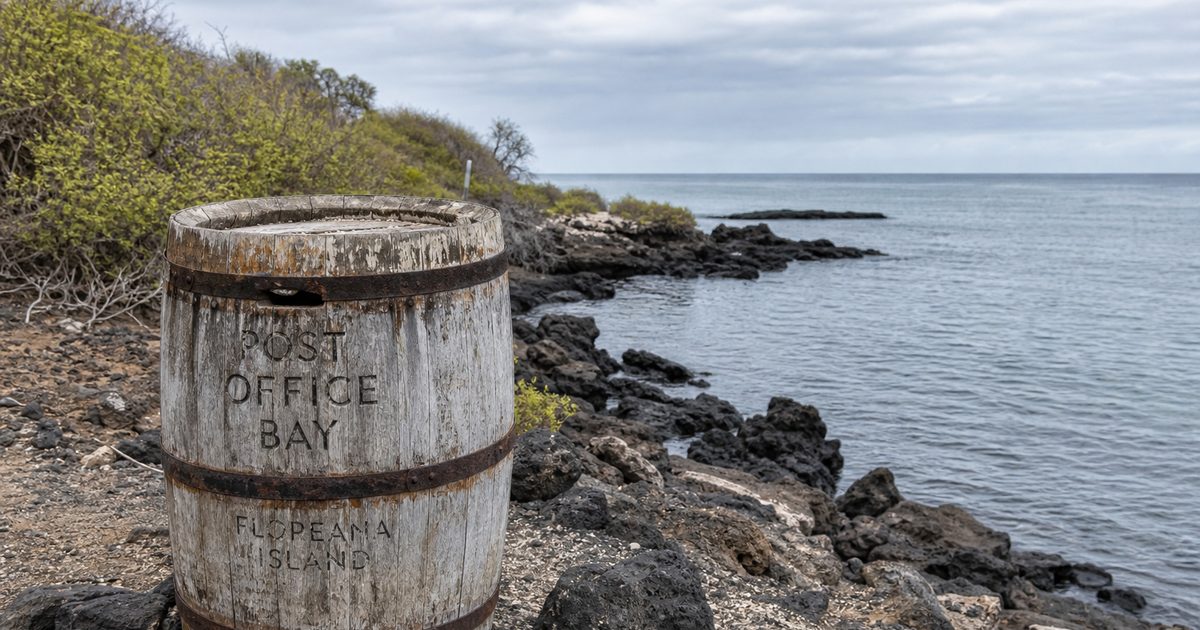
In a wooden barrel at Post Office Bay, letters still wait for strangers. Some are sun-faded. Some have been there for months. The custom is old enough to predate Ecuador, Darwin and every permanent settlement on Floreana. It began in 1793, when British whalers used the bay as an informal mail drop, trusting other ships to carry news home.
That barrel usually gets top billing in any account of Floreana Island. The murders and disappearances of the 1930s are never far behind. But the deeper story of this small inhabited island in the southern Galápagos is not really about intrigue. It is about ecological damage done in slow layers, then the difficult work of undoing it.
Floreana covers 173 square kilometers and rises to 640 meters at Cerro Pajas. Its population is small, usually given at roughly 100 to 160 people, most of them in Puerto Velasco Ibarra. Those numbers matter because they explain the scale of what happened here. On a compact island, a few introduced animals, a few failed settlement schemes, a few decades of pressure can alter almost everything.
Before the mystery, an island under pressure
Long before Floreana had a stable resident population, it was already part of wider human routes across the Pacific. In the 16th and 17th centuries, pirates used the Galápagos as a refuge beyond easy state control. Floreana offered landing places, fresh meat in the form of tortoises, and relative seclusion. Those early visits did not make a settlement, but they began a pattern that would define the island: people arriving with immediate needs and leaving long consequences.
Whalers followed. Their barrel at Post Office Bay was practical, not picturesque. Sailors left unstamped letters in the hope that another crew, heading toward Europe or the Americas, would hand them on. The ritual survives, but its origin belongs to a hard maritime world of long absences and uncertain return.
The first recorded resident came soon after. Patrick Watkins, an Irishman, lived on Floreana after being marooned there in the early 19th century. Accounts of his stay differ in detail, but his presence marks the start of a recurring Floreana theme: outsiders imagining they could bend an isolated volcanic island to their own plan.
In 1832, Ecuador attempted to colonize the island as a penal settlement. The effort failed. The reason was plain and stubborn: water. Fresh water has shaped nearly every human chapter on Floreana, setting limits on agriculture, settlement and survival.
Three years later, Charles Darwin arrived aboard HMS Beagle. His visit was brief, but Floreana entered a much larger scientific history through species later linked to his developing ideas about variation and evolution. The Floreana Mockingbird would become especially important in hindsight. That bird now survives only on two small offshore islets, which says as much about the island’s damage as any archive does.
The settlers and the legend that swallowed the island
Modern Floreana Island history is often told through the settlers of the early 20th century, and for once the fascination is understandable. In 1924, Norwegian immigrants tried to establish a fish canning operation. It failed, another reminder that remoteness was not a romantic condition here but an economic and practical obstacle.
Then came the Europeans whose names still cling to the island. In 1929, Friedrich Ritter, a German doctor, and Dore Strauch arrived in search of a self-fashioned life apart from the world they had left. In 1932, Margret and Heinz Wittmer followed. Their son Rolf is widely described as the first person born in the Galápagos. Soon after, the Austrian Baroness Eloise Wagner de Bosquet arrived with companions and grand plans of her own.
What happened next became the Galapagos Affair. The outline is clear. The truth is not.
In 1934, the Baroness and one of her companions disappeared. Another companion was later found dead. Ritter also died that same year under disputed circumstances. Books, documentaries and dramatizations have kept the story alive, often treating Floreana as a stage set for jealousy, fantasy and murder. The events remain unsolved, and the surviving accounts contradict one another.
That uncertainty matters. The affair belongs to the island’s history, but it can distort it too. Floreana was not simply a backdrop for eccentric Europeans. It was a hard place to live, with scarce resources, social isolation and a landscape that refused easy domesticity. At Asilo de la Paz, caves used by early settlers still make that plain. They are less romantic than the legend suggests. They speak of improvisation, discomfort and the daily strain of making a home where the basics were never guaranteed.
The real rupture was ecological
The island’s most lasting upheaval did not come from scandal. It came from introduced animals.
As settlement deepened, invasive mammals spread across Floreana, including rats, mice and feral cats. On oceanic islands, where many native species evolved without mammalian predators, that kind of arrival can be catastrophic. Eggs, chicks and small animals become easy prey. Competition shifts. Plant communities change. Losses begin quietly, then accumulate.
On Floreana, they accumulated heavily enough to make the island one of the most ecologically compromised in the archipelago. The damage was not abstract. Invasive rodents reportedly affected 80 to 90 percent of local farmers’ crops, which tied conservation directly to livelihood. On a small inhabited island, there is no clean line between environmental crisis and domestic one.
The toll on native life has been severe. Fifty-five species on Floreana are listed as Threatened on the IUCN Red List. Between 12 and 13 endemic species have been lost locally from the island. That phrasing matters: locally lost does not always mean globally extinct, but it does mean the original ecological fabric has been torn.
Some absences carry unusual weight. The Floreana Mockingbird, Mimus trifasciatus, survives only on Champion and Gardner islets off the main island. It is critically endangered. Once part of Floreana’s living landscape, it now persists beyond the reach of the pressures that drove it out. The species became famous because of its place in Darwin’s story. Its disappearance from the main island is a sharper fact than the fame.
The Floreana Giant Tortoise presents another case where history and ecology meet. For a long time, the native tortoise of the island was treated as gone from Floreana itself. The island that had helped feed passing sailors and settlers had lost the animal most associated with the Galápagos. That loss was not symbolic. It changed grazing patterns, seed dispersal and the structure of habitats shaped over long periods by large herbivores.
This is the central paradox of Floreana. The same human presence that made the island legible to history also stripped away much of the living world that made it scientifically important.
Repairing an inhabited island
Restoration on Floreana has had to match the scale of the damage. It also has had to reckon with something many rewilding projects do not: people live here.
The Floreana Ecological Restoration Project aims to remove invasive rodents and cats, reintroduce native species and rebuild habitats across the island. It is often described as the most ambitious restoration effort yet attempted in Galápagos. That sounds large, but the interesting part is not the slogan. It is the setting. This is not an empty reserve cleared for experiment. It is a settled island where conservation enters farms, footpaths, shore landings and household routines.
That makes local participation more than a nice extra. It is the condition of success. With a population small enough that everyone feels the effects of ecological change, restoration becomes immediate. Fewer rats means fewer crop losses. Fewer feral cats can mean better survival for native birds. The work is technical, but its consequences are intimate.
A major turning point came in late 2023, when the first phase of invasive-species eradication removed most rats and feral cats from the island. “Most” matters here. Ecological recovery rarely arrives as a clean ending. It comes in stages, through monitoring, setbacks and signs that may look modest until you understand what was missing before.
Then those signs began to appear.
In 2024, the Pachay, or Galápagos Rail, was recorded on Floreana again after not being seen there since Darwin’s visit in 1835. Rediscovery is one of those words that can sound inflated, but in this case it marks something precise: a bird once absent from the island’s known recent record was present again. The same year, the Galápagos Petrel colony showed strong breeding numbers, with 700 nests and 154 fledglings recorded. Also in 2024, Floreana Giant Tortoises were reintroduced.
Those developments do not erase the losses. Nor do they settle every timeline. Different organizations give different target dates for broader ecological recovery, ranging from the late 2020s into 2030. What matters more than the deadline is the direction. On an island often framed as a cautionary tale, recovery is no longer theoretical.
Reading the island through its scars
Floreana still makes its history visible in the landscape, but the most revealing sites are not separate attractions so much as clues in one long argument between human ambition and ecological limit.
Post Office Bay preserves a maritime custom that has outlived the world that made it necessary. Asilo de la Paz recalls the physical hardship of early settlement more honestly than any retelling of the Galapagos Affair. Playa Negra marks one of the shores where colonists came ashore. At Cormorant Point, a green sand beach colored by olivine lies near a lagoon used by Galápagos flamingos. Offshore sits Devil’s Crown, the broken ring of an eroded volcanic cone.
Taken together, these places show how Floreana Island history and ecology cannot be separated. The same island that carries stories of whalers, settlers and vanished baronesses also holds the record of predation, extinction and attempted repair. Even the famous barrel at Post Office Bay belongs in that frame. It is a relic of movement, exchange and human use of a remote island long before anyone spoke of restoration.
The legal framework matters too. Floreana lies within the Galápagos National Park and the wider UNESCO World Heritage site. Access to parts of the island is regulated, and that restraint is not bureaucratic decoration. It reflects a hard lesson learned here more clearly than in most places: repeated small human actions can transform an entire island system. Reversing that takes patience, science and limits that people accept.
For now, the most important changes are easy to miss if you come looking only for legend. A rail appears where none had been seen for generations. Petrels breed in stronger numbers. Tortoises return to ground that had lost them. Residents who live with the island’s constraints help make those returns possible.
That is the deeper Floreana story. Not the barrel. Not the Baroness. An inhabited island trying, carefully, to become livable again for more than humans.
FAQ
What is the Galapagos Affair on Floreana?
The Galapagos Affair refers to the disappearances and deaths among European settlers on Floreana in the 1930s, especially those involving Friedrich Ritter, Dore Strauch, the Wittmers and Baroness Eloise Wagner de Bosquet. The events are documented, but the exact sequence and motives remain disputed.
Can you still send mail from Post Office Bay?
Yes. Visitors still leave unstamped letters in the barrel at Post Office Bay and may hand-deliver mail if they are traveling near the recipient’s address, continuing a tradition that began in 1793.
What is the main ecological problem on Floreana Island?
The main problem has been invasive mammals, especially rats, mice and feral cats. They preyed on native wildlife, damaged crops and contributed to major biodiversity loss.
Are there giant tortoises on Floreana Island now?
Floreana’s native giant tortoise was long absent from the island. Reintroduction began in 2024 as part of the restoration effort.
Why is the Floreana Mockingbird important?
The Floreana Mockingbird is critically endangered and survives only on Champion and Gardner islets. It is also historically important because mockingbirds from the Galápagos helped shape later thinking about evolution after Darwin’s voyage.