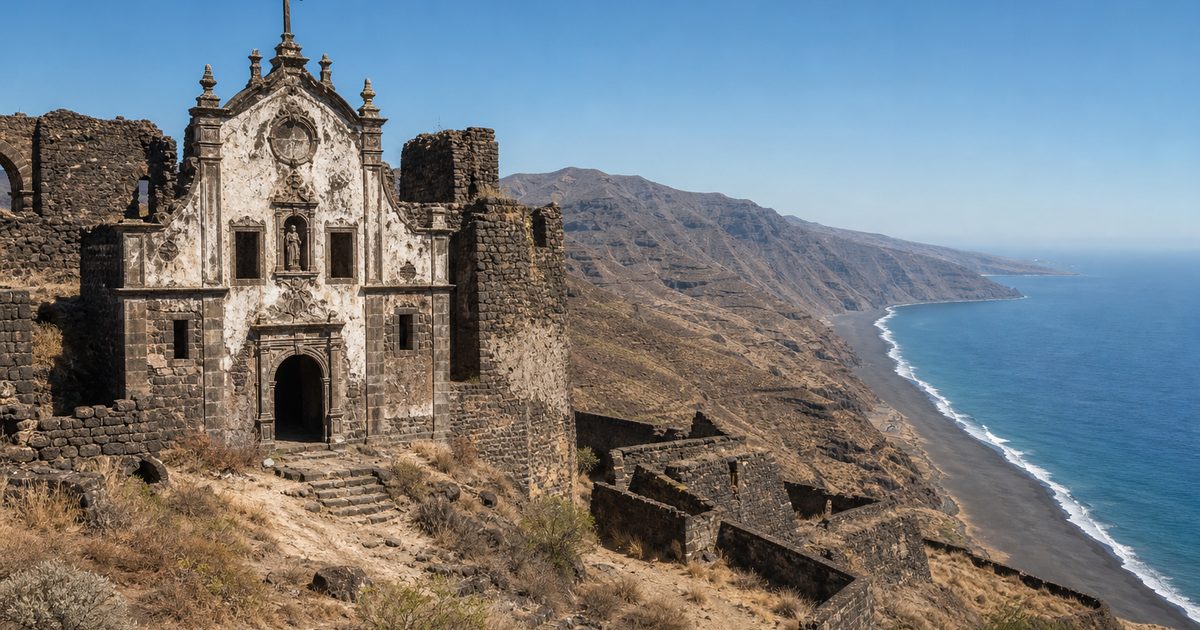
Stone steps, a pillory, a fort on the ridge: in Cidade Velha, the Atlantic world still has an address. What began here in the 1460s on Santiago was not simply the first town in the Cape Verde Islands. It was one of the earliest laboratories of European colonial rule in the tropics, and a place where trade, slavery, and cultural mixing were bound together with unusual force.
The old name was Ribeira Grande. The newer one, Cidade Velha, can sound almost gentle. The history is not. On these volcanic islands off the West African coast, Portuguese settlers built a port that linked Europe, Africa, and later the Americas. That position made Cabo Verde strategically useful. It also made it complicit, and then deeply entangled, in the transatlantic slave trade.
This is the deeper story of the archipelago as an Atlantic crossroads: not a tale of maritime opportunity in the abstract, but of how geography turned into power, how power turned into coercion, and how a Creole society emerged from that violence.
A settlement on empty islands
Before the Portuguese arrived, the archipelago was uninhabited. That fact shaped the colony from the beginning. There was no local court to negotiate with, no existing port to take over, no settled population to govern. For the crown, the islands offered space for experiment.
The exact date of first sighting remains disputed. Accounts place the discovery of the islands between the mid-1450s and 1460, and the names most often associated with it are António de Noli, Alvise Cadamosto, and Diogo Gomes, all tied to voyages under Portuguese patronage. What is clear is the next step: by 1461 or 1462, settlement had begun on Santiago.
Ribeira Grande became the key site. It is widely described as the first permanent European settlement in the tropics, and it quickly grew beyond the scale of an isolated outpost. The Portuguese had found a point in the eastern Atlantic, roughly 570 kilometers from the African mainland, where sea routes and imperial ambition could meet.
The first settlers did not form a neat colonial community. They came from different corners of the Portuguese world. Some arrived from Portugal itself, including the Algarve. Others came from Atlantic islands such as the Azores. The text also points to Jewish migrants and deportees sent by the crown. That mix mattered. Cabo Verde began as a frontier society, unstable and improvised, rather than a carefully ordered transplant of Lisbon.
Why Cabo Verde mattered so much
A colony becomes a crossroads when rulers give geography a function. In 1466, King Afonso V granted settlers in the islands trading rights on the West African coast, with the exception of Arguim. That decision changed everything. It turned the settlement into an intermediary zone between the African mainland and the wider Portuguese Atlantic.
The location made that role practical. Ships could call for water and provisions. Traders could move between the islands and the nearby coast. Goods could be assembled, exchanged, and forwarded. Over time, people were treated the same way.
That is the central fact in the history of the Cape Verde Islands. Their rise in the Atlantic system cannot be separated from slavery. Between the 16th and 19th centuries, the archipelago served as a major node in the movement of enslaved Africans across the ocean. Captives passed through its ports before the Middle Passage. Others were forced to work on the islands themselves.
The economy was not limited to shipping. Textile production also tied Cabo Verde to mainland trade. Locally made cotton cloths, known as panos, circulated on the West African coast and became part of the exchange system that underpinned regional commerce. The islands were therefore not just a stop on a route. They were a place where Atlantic trade took material form.
One figure captures the structure of that society with brutal clarity. In 1580, Santiago is said to have had 14,000 enslaved people and 2,000 free inhabitants. Even if one reads such early colonial numbers with caution, the imbalance is unmistakable. This was a slave society. The port’s importance rested on coercion, labor, and captivity.
Ribeira Grande: wealth under threat
Ports that grow rich on ocean traffic also attract attack. Ribeira Grande learned that early. In 1585, Sir Francis Drake attacked and sacked the town. The blow exposed a weakness built into the place itself. Its position made it valuable, but also vulnerable.
The answer still stands above the town. The São Filipe Royal Fort was built on higher ground after Drake’s raid, intended to protect the settlement and its harbor. The fort is often read as a military monument, but it is also a map in stone. It shows what the town had become: a place important enough to defend because it sat inside contested Atlantic sea lanes.
Pressure did not end with Drake. Pirate attacks continued to unsettle Ribeira Grande, and the colonial government eventually shifted to Praia in 1614. The old capital lost further ground after a French attack in 1712. Praia officially became the capital in 1770.
That transfer of power was more than an administrative footnote. It marked a change in the internal geography of Cabo Verde. Ribeira Grande remained the symbolic point of origin, but the center of government moved to a site judged safer and more practical. The first settlement had made the islands important. It could not guarantee control over the forces it had helped unleash.
The society made in the port
The most lasting result of this Atlantic role was not a fort, a charter, or a customs house. It was the making of a Creole society.
In Cabo Verde, cultural mixture did not emerge from equal exchange. It grew in a colonial order shaped by slavery, forced migration, and unequal power. European settlers, free Africans, enslaved Africans, and their descendants created a social world that was neither simply Portuguese nor simply West African. The result was something distinct.
Language offers the clearest evidence. Cape Verdean Creole, often called Kriolu or Crioulo, developed through sustained contact between Portuguese and West African linguistic systems. The article describes it as drawing archaic Portuguese vocabulary together with West African grammar and syntax. However specialists classify its formation, the broader point stands: the language preserves the history of contact in everyday speech.
Culture followed the same path. Music in the islands carries this layered inheritance, though each genre has its own history and should not be flattened into a single formula. Morna later became the best-known expression abroad, and UNESCO added it to its Intangible Cultural Heritage list in 2019. Batuko, funaná, and coladeira belong to the same wider story of cultural formation, though they arose in different contexts. Food does too. Cachupa is often treated as a national dish because it gathers several historical currents into one pot.
It is tempting to describe this as fusion and stop there. That would be too simple. The society of Cabo Verde was creative, but its creativity emerged within a violent system. Kriolu, music, and everyday customs are not decorative by-products of trade. They are the human record of an Atlantic order built through domination as well as exchange.
After the slave trade
When the slave trade declined, the islands entered a harder period. A system that had made the archipelago useful had also made it dependent on traffic controlled elsewhere. As those networks changed, economic strain deepened and emigration grew.
Geography still mattered. Ships continued to use the islands as a resupply point on mid-Atlantic routes. Yet the older commercial centrality had weakened. Cabo Verde remained connected, but under altered terms.
The article states that slavery in Cabo Verde was abolished in 1878, after an uprising in 1853. What matters here is the long duration. The structures of enslavement outlasted the peak centuries of Atlantic slaving and remained embedded deep into the modern era.
Portuguese rule lasted much longer still. Independence came in 1975. By then, the islands had accumulated centuries of Atlantic history: colonial institutions, African ancestry, a Creole language, and migration patterns that stretched far beyond the archipelago.
That diaspora is one of the clearest legacies of the crossroads. More people of Cape Verdean descent live abroad than on the islands themselves, according to the figures in the text. Communities took root in the United States, especially New England, as well as in Portugal, France, the Netherlands, Italy, and Senegal. Movement shaped the country early, and it never stopped.
What survives in Cidade Velha
Today the old core of Ribeira Grande is protected as a UNESCO World Heritage site. The designation matters, but the place matters more. Cidade Velha is not significant because it is picturesque. It matters because it preserves one of the earliest built landscapes of the Atlantic colonial system.
The Pelourinho, the pillory in the town, condenses that history into a single object. It represented municipal authority. Tradition also associates it with the punishment of enslaved people. Even where details of use can be difficult to document with precision, the symbolism is plain enough. Public power here rested on hierarchy and force.
Above the town, the São Filipe Royal Fort still looks down toward the coast. Read together, fort and pillory tell the story of Ribeira Grande more honestly than any celebratory account of maritime heritage. One guarded wealth from outside attack. The other enforced order within.
The wider culture of Cabo Verde carries the same past in less visible ways. Kriolu remains widely spoken. Morna still carries the emotional weight of distance, memory, and movement. Praia, capital since 1770, reflects later chapters of the national story, but Cidade Velha remains the place where the Atlantic pattern first took hold.
There is also local legend. One story claims that Drake hid treasure in Cabo Verde and that the map was lost. As history, it belongs with legend. As metaphor, it says something useful. The real inheritance of the islands was never buried gold. It was a society formed by trade, violence, migration, and invention in the middle of the ocean.
FAQ
What is Cidade Velha known for?
Cidade Velha, formerly Ribeira Grande on Santiago, is known as the earliest colonial center of Cabo Verde and is recognized by UNESCO for its role in early Atlantic history.
Were the Cape Verde Islands inhabited before the Portuguese arrived?
No. The islands were uninhabited before Portuguese settlement began in the 15th century.
What role did Cabo Verde play in the transatlantic slave trade?
Cabo Verde served as a major Atlantic hub where ships resupplied, goods were exchanged, and enslaved Africans were moved through the islands toward the Americas.
What is Kriolu in Cabo Verde?
Kriolu is Cape Verdean Creole, a language shaped by long contact between Portuguese and West African linguistic traditions.
Why is Ribeira Grande important in Atlantic history?
Ribeira Grande, now Cidade Velha, was the first permanent European settlement in the tropics and an early center of trade, slavery, and colonial administration in the Atlantic world.